Fuel Tanker Capacity: How Many Litres Does a Fuel Tanker Hold?
9 de setembro de 2026
CHENLU Engineering Team | Trailer Engineering and Customization Team | Updated October 2026
Quick answer: A fuel tanker semi-trailer commonly carries 30,000 to 60,000 litres (about 7,900 to 15,900 US gallons), depending on axle count, fuel density and the weight limits of the roads it runs on. Smaller rigid tank trucks usually carry well under 20,000 litres. CHENLU fuel tanker trailers are built with 40,000 to 50,000 litres of total volume, split into a single compartment or 2 to 7 compartments.
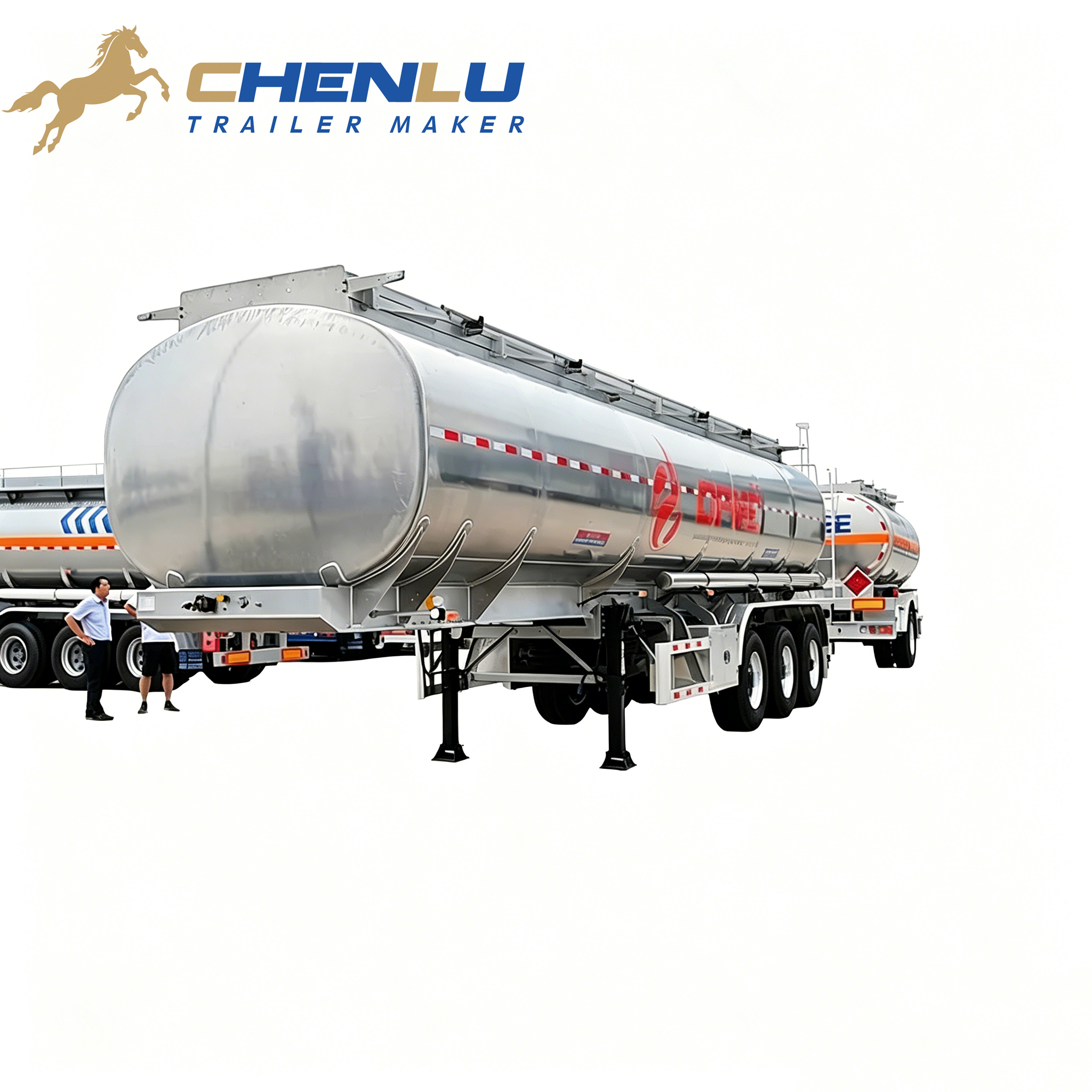
A 40,000 litre aluminum tanker trailer: tank material, compartments and axles are sized together.
Fuel tanker capacity cannot be chosen from volume alone. The same tank holds a different weight of petrol than of diesel, and the loaded weight, not the litres, is what road law limits. This guide gives you the typical capacity ranges, the conversions buyers ask for, and a step-by-step way to size a tanker for your fuel and route.
How many litres does a fuel tanker hold?
Capacity depends mainly on the type of vehicle and the number of axles:
Vehicle type
Typical total capacity
Notas
Rigid tank truck (fuel bowser)
Commonly 5,000-20,000 L
Local delivery to filling stations, farms and sites
2- or 3-axle fuel tanker semi-trailer
Commonly 30,000-50,000 L
Most common for long-distance fuel haulage
4-axle or larger fuel tanker semi-trailer
Up to about 60,000 L where road law allows
Higher volume needs more axles to stay within axle-load limits
These are general industry ranges, not legal limits. Your permitted load depends on the destination country’s gross-weight and axle-load rules.
In the United States, a road tanker for gasoline is often cited at around 9,000 US gallons (about 34,000 litres). In many export markets, 40,000 to 50,000 litre tri-axle tankers are common.
Fuel tanker capacity in litres, gallons and tons
Because petrol is lighter than diesel, the same tank volume produces a different load weight. The table uses typical densities of about 0.74 kg/L for petrol (gasoline) and 0.84 kg/L for diesel; actual density varies with fuel grade and temperature.
Tank volume (litres)
US gallons
Imperial gallons
Petrol weight (approx.)
Diesel weight (approx.)
30,000 L
7,925
6,599
22.2 t
25.2 t
35,000 L
9,246
7,699
25.9 t
29.4 t
40,000 L
10,567
8,799
29.6 t
33.6 t
45,000 L
11,888
9,899
33.3 t
37.8 t
50,000 L
13,209
10,998
37.0 t
42.0 t
60,000 L
15,850
13,198
44.4 t
50.4 t
Conversions: 1 US gallon = 3.785 L; 1 imperial gallon = 4.546 L; 1 m³ = 1,000 L. Liquid weight = volume × density. Tonnes shown are cargo weight only, without the trailer and tractor.
This is why a 50,000 litre tank that is legal for petrol can be overweight with diesel on the same route: the diesel load is about 5 tonnes heavier.
Fuel tanker capacity starts with payload, not tank volume
The first calculation is the mass of the liquid. Multiply the planned volume by the operating density, then compare that mass with the permitted payload after deducting the tractor and trailer tare weights. The same tank volume creates a different axle load and gross-combination mass when the product changes.
Do not treat the tank’s geometric volume as its guaranteed usable volume. Outage (the space left for thermal expansion), loading procedure and compartment rules can reduce the quantity carried. The applicable authority and the cargo-handling procedure determine the final fill limit.
How to calculate the right tanker capacity, step by step
Defina o líquido: registe o produto exato, a densidade de funcionamento, o intervalo de temperatura e os requisitos de compatibilidade.
Confirmar os limites do percurso: check permitted gross mass, axle-group limits, dimensions and any restricted roads in the destination market.
Determinar o peso de tara: include tank material, axles, suspension, pump, piping, vapor-recovery equipment, guards and other accessories.
Calcular a carga útil: subtract the tractor and trailer tare weights from the permitted combination mass, and check each axle group.
Converter massa em volume: dividir a carga útil líquida admissível pela densidade de funcionamento.
Aplicar restrições de preenchimento: allow for outage, compartment loading rules and the operating procedure before fixing the nominal tank volume.
Worked example (illustrative): if your route allows 36 tonnes of liquid payload after tare weights, that equals about 48,600 litres of petrol (36,000 kg ÷ 0.74) but only about 42,900 litres of diesel (36,000 kg ÷ 0.84). A tank sized for the diesel case, then used for petrol, simply runs partly empty; a tank sized for petrol and filled with diesel can be overweight.
O que é que altera a capacidade útil?
Fator
Efeito da capacidade
É necessária a opinião do comprador
Densidade do líquido
Uma densidade mais elevada atinge o limite de massa com um volume menor
Densidade do produto e densidade operacional
Material do depósito
Material and structure change tare weight and available payload
Aço ao carbono, alumínio ou outro material compatível
Planta dos compartimentos
As anteparas, as tubagens e as válvulas aumentam o peso, mas permitem um abastecimento separado
Número de produtos, gotas e sequência de descarga
Disposição dos eixos
O volume total pode ainda sobrecarregar um grupo de eixos
Configuração do trator, número de eixos e limites legais para os eixos
Bomba e acessórios
Equipment adds tare weight and takes space
Requisitos relativos ao carregamento, descarga e controlo de vapores
Percurso e temperatura
Road restrictions and expansion allowance can reduce the load
Países, condições da rota e intervalo de temperaturas
Tanker truck dimensions and capacity
Length, width and height set the physical limit on tank volume. For reference, CHENLU fuel tanker semi-trailers rated 40,000-50,000 litres measure 10,200-12,000 mm long, 2,500 mm wide and 3,800-3,990 mm high, with a tare weight of about 7,500-15,000 kg depending on configuration. A longer custom build delivered to a customer in Congo carries 50,000 litres in five compartments at 16,500 × 2,500 × 3,850 mm. Always check the destination’s maximum length and height before choosing a larger tank. For full length, width and height ranges by tanker type, see our Guia de dimensões de reboques-cisterna.
Configurações dos camiões-cisterna de combustível CHENLU
Parâmetro
CHENLU specification
Volume total
40,000-50,000 L
Compartimentos
Single, or 2 to 7; each hydrostatically tested to 5 psi (35 kPa)
Corpo do tanque / calotas
Aço-carbono Q235 de 5 mm ou 6 mm
Eixos
2 or 3 axles (13T/16T) on the standard chassis; a 4-axle petrol tanker model is also available
Válvulas
3″ Euro-standard ball valve; 2 × 4″ bottom valves with pneumatic control
Options
Insulation, oil vapor recovery system and pump unit (on the 40,000 L multi-compartment tanker)
A single-compartment tank simplifies the internal arrangement and suits one product delivered as one load. Multiple compartments let you carry different fuels, such as petrol and diesel, or serve several delivery points on one trip, but bulkheads, valves and pipework add tare weight and operating steps. For example, a 45,000 litre tank might be divided into five compartments of 9,000 litres each, so each filling station receives a measured drop. Partial loading needs careful planning, because liquid movement and uneven compartment use affect axle loads and stability.
Erros comuns na escolha do tamanho
Encomendas apenas em litros: a nominal volume does not prove the loaded combination meets mass limits.
Using one density for every fuel: diesel is roughly 13% heavier than petrol for the same volume.
Ignorar a tara do trator: Dois tratores acoplados ao mesmo camião-cisterna podem deixar margens de carga útil diferentes.
Partindo do princípio de que cada compartimento pode ser parcialmente enchido: loading sequence and liquid movement need an approved operating plan.
Aplicar os limites de um país noutros locais: Os requisitos relativos aos eixos, às dimensões e às mercadorias perigosas variam consoante o mercado e o percurso.
Adicionar equipamento posteriormente: pumps, hose carriers and vapor hardware consume payload and can change weight distribution.
As verificações de conformidade devem constar da especificação
O Fórum Mundial da UNECE para a Harmonização das Normas Relativas aos Veículos maintains international vehicle regulations covering braking, lighting, tires and coupling devices. The exact vehicle and dangerous-goods rules depend on the product, destination and approval route. CHENLU configures tankers to the regulations of your destination country, confirmed at inquiry; a general compliance statement cannot replace order-specific documentation.
Fuel tanker capacity FAQ
What is the capacity of a fuel tanker?
A fuel tanker semi-trailer commonly holds 30,000-60,000 litres, and a rigid tank truck usually holds under 20,000 litres. CHENLU fuel tanker trailers hold 40,000-50,000 litres. The right size for your order depends on fuel density, tare weight and the axle-load limits of your route.
What is the capacity of a petrol tanker?
Petrol tankers use the same tank sizes as diesel tankers, commonly 30,000-60,000 litres on a semi-trailer. Because petrol is lighter (about 0.74 kg/L), a 40,000 litre petrol load weighs about 29.6 tonnes, compared with about 33.6 tonnes for diesel.
How many gallons does a tanker truck hold?
A semi-trailer fuel tanker of 30,000-60,000 litres holds about 7,900-15,900 US gallons. A 40,000 litre tank is about 10,600 US gallons; a 50,000 litre tank is about 13,200 US gallons.
How much does a full fuel tanker weigh?
Add the cargo weight to the tare weights. A 45,000 litre diesel load weighs about 37.8 tonnes; with a trailer tare of 7.5-15 tonnes and the tractor, the combination must still be within your route’s gross and axle limits.
How many compartments should a fuel tanker have?
Base it on the number of products, delivery points, loading sequence and cleaning needs. CHENLU tankers are available as single-compartment or with 2 to 7 compartments.
É possível carregar sempre o volume nominal total?
No. Payload mass, axle distribution, expansion allowance, temperature, route limits and compartment rules can restrict the usable load below the geometric tank volume.
Que informações são necessárias para obter um orçamento?
Provide the fuel and its density, target volume, compartment plan, loading and discharge method, tractor configuration, destination country, route conditions and required accessories. Pricing is factory-direct and confirmed on inquiry.
Responder-lhe-emos no prazo de 24 horas. Em caso de urgência, adicionar WhatsApp/WeChat: 86-15628801159,. Ou ligue diretamente para 86-15628801159.
*Respeitamos a sua confidencialidade e todas as informações são protegidas.
Apenas utilizaremos as suas informações para responder ao seu pedido e nunca enviaremos mensagens de correio eletrónico ou mensagens promocionais não solicitadas.




 9 de setembro de 2026