Fuel Tanker Capacity: How Many Litres Does a Fuel Tanker Hold?
09 September 2026
CHENLU Engineering Team | Trailer Engineering and Customization Team | Updated October 2026
Quick answer: A fuel tanker semi-trailer commonly carries 30,000 to 60,000 litres (about 7,900 to 15,900 US gallons), depending on axle count, fuel density and the weight limits of the roads it runs on. Smaller rigid tank trucks usually carry well under 20,000 litres. CHENLU fuel tanker trailers are built with 40,000 to 50,000 litres of total volume, split into a single compartment or 2 to 7 compartments.
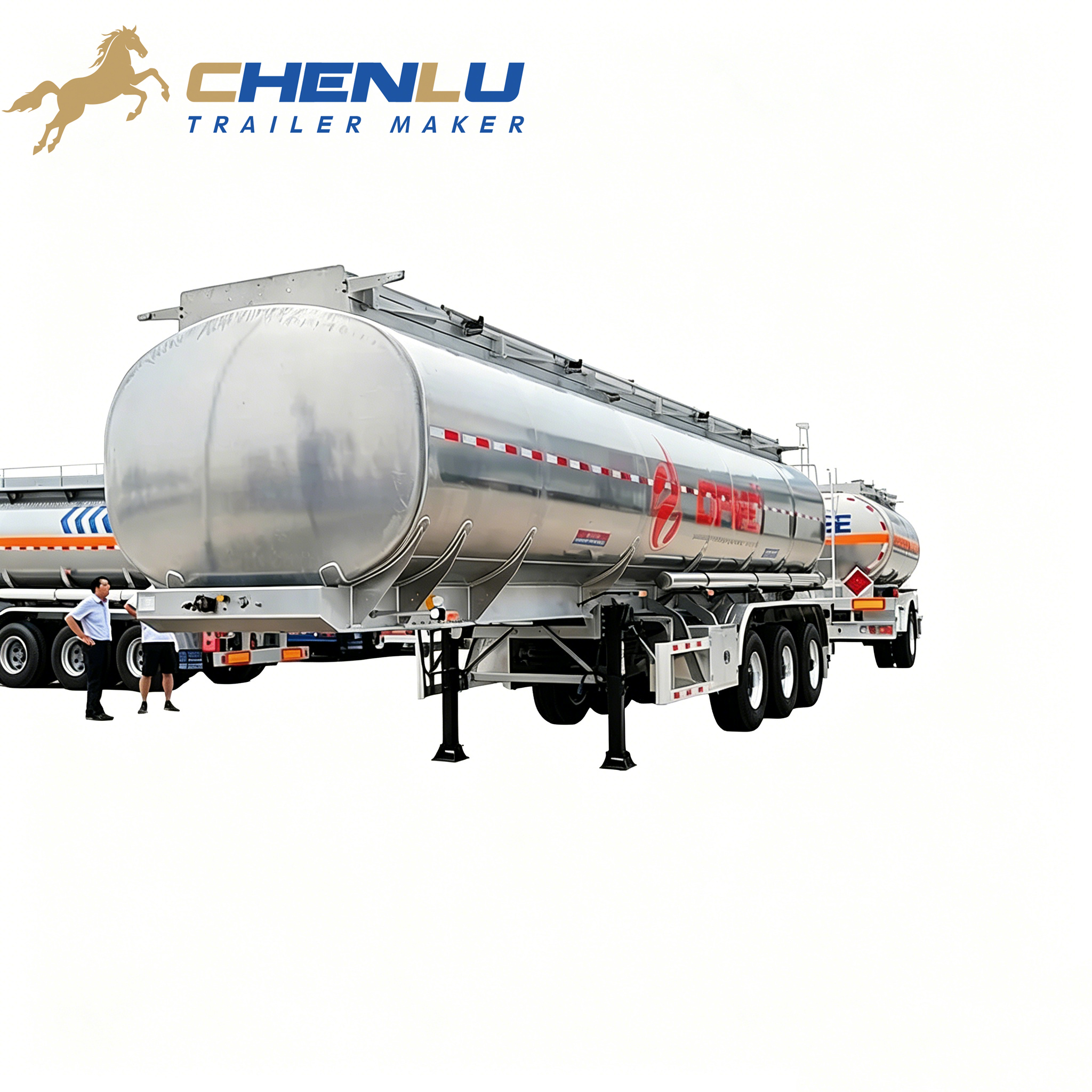
A 40,000 litre aluminum tanker trailer: tank material, compartments and axles are sized together.
Fuel tanker capacity cannot be chosen from volume alone. The same tank holds a different weight of petrol than of diesel, and the loaded weight, not the litres, is what road law limits. This guide gives you the typical capacity ranges, the conversions buyers ask for, and a step-by-step way to size a tanker for your fuel and route.
How many litres does a fuel tanker hold?
Capacity depends mainly on the type of vehicle and the number of axles:
Vehicle type
Typical total capacity
Notes
Rigid tank truck (fuel bowser)
Commonly 5,000-20,000 L
Local delivery to filling stations, farms and sites
2- or 3-axle fuel tanker semi-trailer
Commonly 30,000-50,000 L
Most common for long-distance fuel haulage
4-axle or larger fuel tanker semi-trailer
Up to about 60,000 L where road law allows
Higher volume needs more axles to stay within axle-load limits
These are general industry ranges, not legal limits. Your permitted load depends on the destination country’s gross-weight and axle-load rules.
In the United States, a road tanker for gasoline is often cited at around 9,000 US gallons (about 34,000 litres). In many export markets, 40,000 to 50,000 litre tri-axle tankers are common.
Fuel tanker capacity in litres, gallons and tons
Because petrol is lighter than diesel, the same tank volume produces a different load weight. The table uses typical densities of about 0.74 kg/L for petrol (gasoline) and 0.84 kg/L for diesel; actual density varies with fuel grade and temperature.
Tank volume (litres)
US gallons
Imperial gallons
Petrol weight (approx.)
Diesel weight (approx.)
30,000 L
7,925
6,599
22.2 t
25.2 t
35,000 L
9,246
7,699
25.9 t
29.4 t
40,000 L
10,567
8,799
29.6 t
33.6 t
45,000 L
11,888
9,899
33.3 t
37.8 t
50,000 L
13,209
10,998
37.0 t
42.0 t
60,000 L
15,850
13,198
44.4 t
50.4 t
Conversions: 1 US gallon = 3.785 L; 1 imperial gallon = 4.546 L; 1 m³ = 1,000 L. Liquid weight = volume × density. Tonnes shown are cargo weight only, without the trailer and tractor.
This is why a 50,000 litre tank that is legal for petrol can be overweight with diesel on the same route: the diesel load is about 5 tonnes heavier.
Fuel tanker capacity starts with payload, not tank volume
The first calculation is the mass of the liquid. Multiply the planned volume by the operating density, then compare that mass with the permitted payload after deducting the tractor and trailer tare weights. The same tank volume creates a different axle load and gross-combination mass when the product changes.
Do not treat the tank’s geometric volume as its guaranteed usable volume. Outage (the space left for thermal expansion), loading procedure and compartment rules can reduce the quantity carried. The applicable authority and the cargo-handling procedure determine the final fill limit.
How to calculate the right tanker capacity, step by step
Define the liquid: record the exact product, operating density, temperature range and compatibility requirements.
Confirm route limits: check permitted gross mass, axle-group limits, dimensions and any restricted roads in the destination market.
Establish tare weight: include tank material, axles, suspension, pump, piping, vapor-recovery equipment, guards and other accessories.
Calculate payload: subtract the tractor and trailer tare weights from the permitted combination mass, and check each axle group.
Convert mass to volume: divide the allowable liquid payload by the operating density.
Apply filling constraints: allow for outage, compartment loading rules and the operating procedure before fixing the nominal tank volume.
Worked example (illustrative): if your route allows 36 tonnes of liquid payload after tare weights, that equals about 48,600 litres of petrol (36,000 kg ÷ 0.74) but only about 42,900 litres of diesel (36,000 kg ÷ 0.84). A tank sized for the diesel case, then used for petrol, simply runs partly empty; a tank sized for petrol and filled with diesel can be overweight.
What changes the usable capacity?
Factor
Capacity effect
Buyer input needed
Liquid density
Higher density reaches the mass limit at a lower volume
Product and operating density
Tank material
Material and structure change tare weight and available payload
Carbon steel, aluminum or another compatible material
Compartment plan
Bulkheads, piping and valves add weight but allow separated deliveries
Number of products, drops and unloading sequence
Axle arrangement
Total volume can still overload one axle group
Tractor layout, axle count and legal axle limits
Pump and accessories
Equipment adds tare weight and takes space
Loading, discharge and vapor-control requirements
Route and temperature
Road restrictions and expansion allowance can reduce the load
Countries, route conditions and temperature range
Tanker truck dimensions and capacity
Length, width and height set the physical limit on tank volume. For reference, CHENLU fuel tanker semi-trailers rated 40,000-50,000 litres measure 10,200-12,000 mm long, 2,500 mm wide and 3,800-3,990 mm high, with a tare weight of about 7,500-15,000 kg depending on configuration. A longer custom build delivered to a customer in Congo carries 50,000 litres in five compartments at 16,500 × 2,500 × 3,850 mm. Always check the destination’s maximum length and height before choosing a larger tank. For full length, width and height ranges by tanker type, see our tanker trailer dimensions guide.
CHENLU fuel tanker configurations
Parameter
CHENLU specification
Total volume
40,000-50,000 L
Compartments
Single, or 2 to 7; each hydrostatically tested to 5 psi (35 kPa)
Tank body / end plates
5 mm or 6 mm Q235 carbon steel
Axles
2 or 3 axles (13T/16T) on the standard chassis; a 4-axle petrol tanker model is also available
Valves
3″ Euro-standard ball valve; 2 × 4″ bottom valves with pneumatic control
Options
Insulation, oil vapor recovery system and pump unit (on the 40,000 L multi-compartment tanker)
A single-compartment tank simplifies the internal arrangement and suits one product delivered as one load. Multiple compartments let you carry different fuels, such as petrol and diesel, or serve several delivery points on one trip, but bulkheads, valves and pipework add tare weight and operating steps. For example, a 45,000 litre tank might be divided into five compartments of 9,000 litres each, so each filling station receives a measured drop. Partial loading needs careful planning, because liquid movement and uneven compartment use affect axle loads and stability.
Common sizing mistakes
Ordering by litres only: a nominal volume does not prove the loaded combination meets mass limits.
Using one density for every fuel: diesel is roughly 13% heavier than petrol for the same volume.
Ignoring tractor tare: two tractors coupled to the same tanker can leave different payload margins.
Assuming every compartment can be partly filled: loading sequence and liquid movement need an approved operating plan.
Using one country’s limits elsewhere: axle, dimension and dangerous-goods requirements vary by market and route.
Adding equipment late: pumps, hose carriers and vapor hardware consume payload and can change weight distribution.
Compliance checks belong in the specification
The UNECE World Forum for Harmonization of Vehicle Regulations maintains international vehicle regulations covering braking, lighting, tires and coupling devices. The exact vehicle and dangerous-goods rules depend on the product, destination and approval route. CHENLU configures tankers to the regulations of your destination country, confirmed at inquiry; a general compliance statement cannot replace order-specific documentation.
Fuel tanker capacity FAQ
What is the capacity of a fuel tanker?
A fuel tanker semi-trailer commonly holds 30,000-60,000 litres, and a rigid tank truck usually holds under 20,000 litres. CHENLU fuel tanker trailers hold 40,000-50,000 litres. The right size for your order depends on fuel density, tare weight and the axle-load limits of your route.
What is the capacity of a petrol tanker?
Petrol tankers use the same tank sizes as diesel tankers, commonly 30,000-60,000 litres on a semi-trailer. Because petrol is lighter (about 0.74 kg/L), a 40,000 litre petrol load weighs about 29.6 tonnes, compared with about 33.6 tonnes for diesel.
How many gallons does a tanker truck hold?
A semi-trailer fuel tanker of 30,000-60,000 litres holds about 7,900-15,900 US gallons. A 40,000 litre tank is about 10,600 US gallons; a 50,000 litre tank is about 13,200 US gallons.
How much does a full fuel tanker weigh?
Add the cargo weight to the tare weights. A 45,000 litre diesel load weighs about 37.8 tonnes; with a trailer tare of 7.5-15 tonnes and the tractor, the combination must still be within your route’s gross and axle limits.
How many compartments should a fuel tanker have?
Base it on the number of products, delivery points, loading sequence and cleaning needs. CHENLU tankers are available as single-compartment or with 2 to 7 compartments.
Can the full nominal volume always be loaded?
No. Payload mass, axle distribution, expansion allowance, temperature, route limits and compartment rules can restrict the usable load below the geometric tank volume.
What information is needed for a quotation?
Provide the fuel and its density, target volume, compartment plan, loading and discharge method, tractor configuration, destination country, route conditions and required accessories. Pricing is factory-direct and confirmed on inquiry.
Get a tanker sized for your fuel and route
Send us the fuel type, target volume, compartment plan and destination country through the CHENLU contact page, and our engineers will check the proposed capacity against your route limits. You can also browse our fuel, aluminum and bulk cement tanker trailers.




 09 September 2026