CHENLU Engineering Team | Updated October 2026
Respuesta rápida: Lowbed trailers (also called lowboy or low bed trailers) come in four main types, grouped by how the machine gets on the deck: fixed gooseneck (loaded from the rear over ramps), removable gooseneck / RGN (the neck detaches so the machine drives on from the front), folding gooseneck (the neck folds down to form a front ramp) and multi-axle lowbeds for very heavy or oversized loads. Choose by machine weight, height and whether it can climb a ramp.
What is a lowbed trailer?
A lowbed trailer is a heavy-haul semi-trailer whose deck sits low between the gooseneck and the rear axles. The low deck keeps the loaded height down, so excavators, bulldozers, loaders and drilling rigs can pass under bridges and power lines. “Lowbed”, “low bed” and “lowboy” describe the same trailer; the name changes by country.
The four main types of lowbed trailer
1. Fixed gooseneck lowbed (standard lowboy)
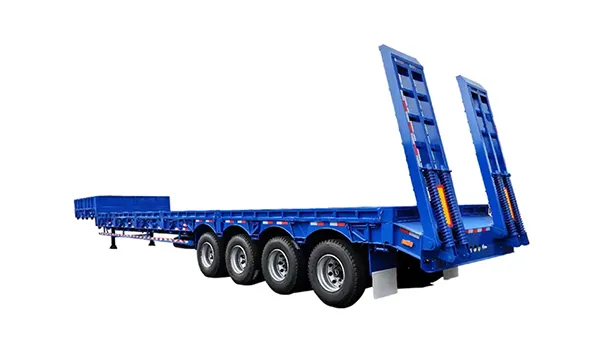
The gooseneck is welded to the deck and machines are driven on from the rear over ramps. It is the simplest, most economical and lowest-maintenance type, and covers most construction equipment.
- CHENLU range: 3-axle rated 30-60 tons, 4-axle rated 60-100 tons; overall 13,000 × 3,000 × 1,760 mm
- Options: mechanical or air suspension, 13/16/20-ton axles, and a hydraulic ladder whose angle adjusts for machines of different heights
- Best for: excavators, wheel loaders and road machinery that can climb rear ramps
2. Removable gooseneck lowbed (RGN)
The gooseneck detaches hydraulically and the front of the deck lowers to the ground, so the machine drives on from the front with no steep ramp. This suits tall machines and equipment with low ground clearance.
- CHENLU example: Remolque desmontable con cuello de cisne de 80 toneladas, 16,000 × 3,000 × 2,500 mm, with a 12 kW diesel engine driving the hydraulic system that separates the gooseneck
- Best for: tall or long equipment, machines that cannot climb ramps, frequent loading at sites without docks
3. Folding gooseneck lowbed
The gooseneck folds down to the ground to create a gentle front slope, rather than detaching completely. Loading is from the front like an RGN, with the neck staying attached to the trailer.
4. Multi-axle lowbed
Extra axle lines spread the load, so the trailer can carry overweight, overwidth or overheight equipment within axle-load limits. These are used for transformers, mining machines and large industrial components.
Lowbed trailer types compared
| Tipo |
Cargando |
Typical use |
Complexity and cost |
| Cuello de cisne fijo |
Rear, over ramps |
General construction equipment |
Lowest |
| Removable gooseneck (RGN) |
Front, deck lowered to ground |
Tall or low-clearance machines |
Higher: hydraulic system to maintain |
| Folding gooseneck |
Front, neck folds into a ramp |
Heavy machines needing a gentle slope |
Higher: hydraulic folding mechanism |
| De varios ejes |
Rear or front, by design |
Overweight and oversized cargo |
Highest: more axles, often permits |
Other heavy-haul designs exist, such as extendable trailers for wind blades and hydraulic modular trailers for very heavy indivisible loads. Ask us about these for project cargo.
How to choose a lowbed type
- Machine weight: sets the axle count and rated capacity. Up to about 60 tons, a 3-axle lowbed usually works; heavier loads need 4 axles or a multi-axle trailer, subject to your road limits.
- Machine height: deck height plus machine height must clear bridges and power lines on your route.
- Can it climb a ramp? Tracked machines usually climb rear ramps. Low-clearance or wheeled machines with long overhangs often need front loading (RGN or folding gooseneck).
- How often you load: frequent loading at different sites favors the simpler, faster type for your machines.
- Budget and maintenance: fixed gooseneck trailers cost less and have fewer hydraulic parts to maintain.
For a side-by-side look at the two most common types, read our lowboy trailer guide and the RGN trailer page.
Lowbed trailer FAQ
What is the difference between a lowbed and a lowboy?
None. Lowbed, low bed and lowboy are names for the same heavy-haul trailer with a low deck. Lowboy is common in North America; lowbed in most export markets.
How much can a lowbed trailer carry?
CHENLU 3-axle lowbeds are rated 30-60 tons and 4-axle lowbeds 60-100 tons; multi-axle versions carry more. The legal payload depends on axle-load limits in your country.
Which lowbed is best for an excavator?
Most tracked excavators load over rear ramps onto a fixed gooseneck lowbed. Very tall or heavy excavators may need an RGN or a 4-axle lowbed to stay within height and axle limits.
Is an RGN better than a fixed gooseneck?
Not always. An RGN loads machines that cannot climb ramps, but costs more and has a hydraulic system to maintain. If your machines climb ramps, a fixed gooseneck is simpler and more economical.
Can a lowbed trailer be customized?
Yes. Axle count and rating, suspension, ramps or hydraulic ladder, and deck width can be configured. Pricing is factory-direct and confirmed on inquiry.
Find the right lowbed for your machines
Send us your equipment weight, dimensions and destination through the contact page, and our engineers will recommend the type and axle configuration.




 21 de octubre de 2026