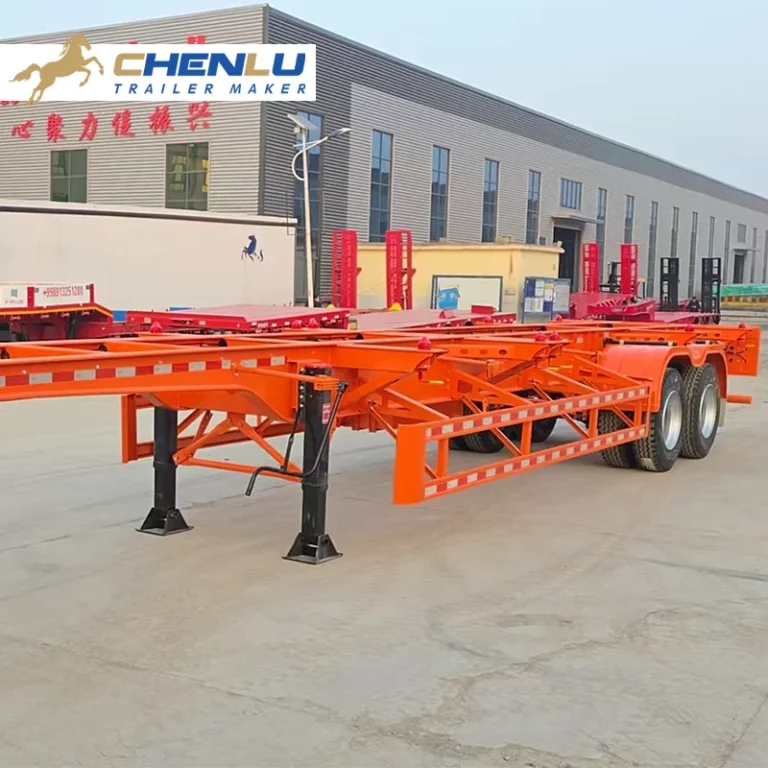
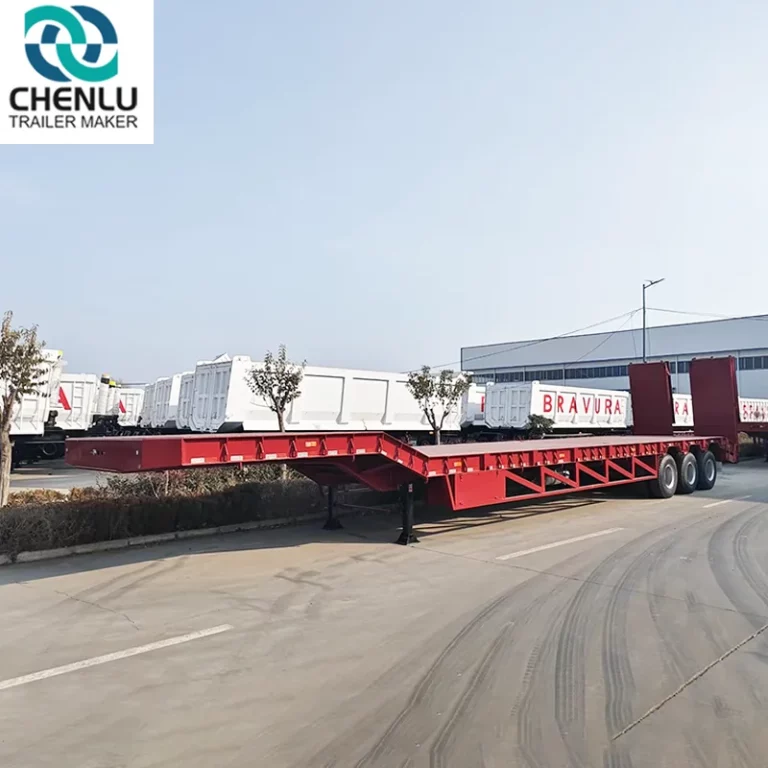
A machine that is too tall, too heavy, or difficult to load can turn a simple haul into a costly problem. The wrong trailer raises transport height, slows loading, and may overload an axle. A properly configured lowboy trailer solves these problems with a lower deck and heavy-duty structure.
A remorque surbaissée is a heavy-duty semi-trailer with a lowered main deck used to haul excavators, bulldozers, loaders, mining machines, and oversized equipment. When choosing one, compare equipment weight and dimensions, deck height and length, axle count, loading method, gooseneck design, route restrictions, and legal weight and height limits.

Schéma de l'article
- What is a lowboy trailer and why is it used for heavy haul?
- How does the deck of a lowboy reduce transport height?
- What are the main types of lowboy trailers?
- Fixed gooseneck vs. RGN: which lowboy trailer is better?
- How do lowboy trailer dimensions affect equipment transport?
- How many axles and how much load capacity do you need?
- Lowboy vs. flatbed, step deck, and double drop: what is the difference?
- How do you choose the right lowboy trailer for your equipment?
- Foire aux questions
What Is a Lowboy Trailer and Why Is It Used to Haul Heavy Equipment?
A lowboy is a specialized semi-trailer with a main cargo deck positioned much lower than a normal flatbed.
The low deck gives the trailer two important advantages: it lowers the center of gravity and creates more vertical room for tall cargo.
This makes lowboys useful for transporting:
- Pelles excavatrices
- Bulldozers
- Chargeuses sur pneus
- Pavers
- Drilling machinery
- Matériel minier
- Agricultural machines
- Industrial equipment
- Cranes and components
- Oversized construction machinery
A normal à plateau may be suitable for steel, containers, or smaller machinery. But once equipment becomes tall or heavy, the lower platform of a semi lowboy trailer becomes more valuable.
At CHENLU, we manufacture lowbed and lowboy transport solutions for construction companies, mining fleets, equipment rental businesses, infrastructure contractors, distributors, and international project buyers. Our current standard product range includes three- and four-axle lowbed configurations as well as hydraulic-ramp and removable-gooseneck designs.
The goal is not simply to haul more weight. It is to move the equipment at a practical transport height while distributing the load correctly across the tractor and trailer.

How Does the Deck of a Lowboy Reduce Transport Height?
The defining feature of a lowboy is its deck height.
A standard flatbed keeps its cargo platform above the wheel and axle structure. A lowboy lowers the main trailer bed between structural sections, placing the machinery closer to the road.
Think of it like this:
Normal flatbed
Tractor → high deck → cargo
Lowboy
Tractor → drop → lower deck → axle section
Because the equipment sits low to the ground, a taller excavator or loader can stay closer to legal transport height.
What Are the Main Types of Lowboy Trailers?
There is more than one type of lowboy. The best structure depends on how the machine will load, how often it moves, and how large it is.
Fixed-Neck Lowboy
A fixed neck lowboy uses a permanent front connection. Equipment normally loads from the rear using a mechanical or hydraulic ramp.
This is one of the most common lowboy trailer configurations for excavators, loaders, and general construction machinery.
Advantages include:
- Simple structure
- Fewer moving connection components
- Practical maintenance
- Competitive cost
- Good fit for machines that can use rear ramps
Fixed Gooseneck Lowboy
A fixed gooseneck provides a strong connection between the tractor and trailer but does not detach for front loading.
Fixed gooseneck lowboys work well when a customer wants the structural benefits of a gooseneck but does not need regular front-loading capability.
Removable Gooseneck Lowboy
A removable gooseneck, commonly called an RGN, allows the front neck to separate from the main trailer.
Once the gooseneck detaches, the front of the trailer can lower toward the ground. A bulldozer, excavator, or other tracked machine can then drive directly onto the main deck.
This makes a detachable gooseneck trailer particularly useful for equipment that is difficult to load over rear ramps.

Extendable Lowboy
An extendable design increases deck length when the cargo is unusually long.
Les applications types peuvent inclure :
- Structural sections
- Industrial equipment
- Long machinery
- Selected energy-project components
For extreme project cargo, however, buyers may need a modular hydraulic transport system rather than a conventional lowboy.
Fixed Gooseneck vs. RGN: Which Lowboy Trailer Is Better?
The biggest difference is the loading method.
| Fonctionnalité |
Fixed Gooseneck Lowboy |
RGN / Detachable Gooseneck |
| Front Neck |
Fixed |
Removable |
| Main Loading Method |
Rear-ramp loading |
Front drive-on loading |
| Hydraulic System |
Not always required |
Common on hydraulic RGN trailers |
| Structure |
Simpler |
More complex |
| Frequent Crawler Loading |
Good |
Excellent |
| Purchase Cost |
Usually lower |
Usually higher |
| Operational Flexibility |
Standard |
Haut |
| Idéal pour |
General machinery |
Large crawler equipment |
An RGN trailer is attractive when you frequently transport machines that can drive under their own power.
A modern hydraulic detachable gooseneck uses hydraulic components to make the detach-and-reconnect process easier. A hydraulic RGN can reduce manual work when the fleet loads machines many times each week.
La situation actuelle de CHENLU removable-gooseneck product example uses a 12 kW diesel-powered hydraulic system for gooseneck separation and equipment loading. The specific displayed model measures 16,000 × 3,000 × 2,500 mm and is positioned as an 80-ton design. Those figures belong to that specific product and should not be treated as universal RGN dimensions.
For a fleet moving excavators or bulldozers every day, hydraulic RGN lowboys may justify their greater complexity. For less frequent loading, a standard rear-ramp lowboy can be more economical.
How Many Axles and How Much Load Capacity Do You Need?
The number of axles affects how trailer weight and equipment weight reach the road.
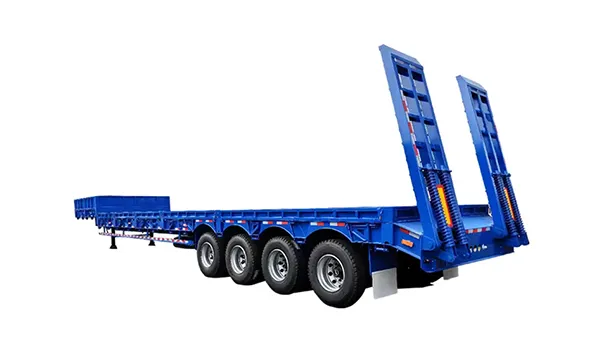
A à trois essieux design is common for standard construction equipment. A four-axle or multi-axle design may be better for a heavier heavy load, depending on local axle rules.
CHENLU’s current lowbed product pages show this general reference range:
| Trailer Configuration |
Current Published Reference Range |
Application type |
| 3 essieux |
30–60 tons |
Excavators and standard construction equipment |
| 4 essieux |
60–100 tons |
Heavy machinery and concentrated loads |
| RGN |
Project-specific |
Crawler machinery and front loading |
| Multi-Axle / Modular |
Project-specific |
Extreme heavy-haul transportation |
The current four-axle pages contain conflicting payload statements, so the actual rated load capacity must be confirmed against the final technical specification.

How Do You Choose the Right Lowboy Trailer for Your Equipment?
Choosing a trailer should start with equipment data.
We recommend answering these questions first.
What Does the Machine Weigh?
Get the real operating weight.
Include attachments when they travel on the machine.
How Tall Is It?
Compare loaded height against route height limits.
A low deck can help, but it does not remove the need for route planning.
How Wide Is It?
Wide machinery may need a wider deck or extendable outriggers.
Can It Drive Onto the Trailer?
If yes, decide whether rear ramps are practical or whether front loading with an RGN would be safer.
Where Will It Work?
A highway fleet has different needs from a mining operator.
Rough construction and mining roads may favor a robust mechanical suspension. Highway-focused operations may consider other suspension requirements.
How Often Will You Load It?
For occasional loading, mechanical ramps can be enough.
For frequent equipment movements, hydraulic ramps or a hydraulic detachable gooseneck can reduce operating effort.
Our engineering team therefore asks for:
- Nom de l’équipement
- Marque et modèle
- Dimensions and weight
- Charge utile cible
- Modèle de tracteur
- Hauteur de la sellette d'attelage
- Pays de destination
- État des routes
- Limites des essieux
- Méthode de chargement
- Quantité commandée
This information lets us recommend the right lowboy trailer instead of simply selling whatever trailer is already in stock.
Why Buy a Custom Lowboy Trailer From a Manufacturer?
Heavy machinery is rarely standardized.
One company moves 25-ton excavators. Another moves mining loaders. Another transports pavers between road projects every day.
One fixed specification cannot serve them all well.
As a professional semi trailer manufacturer in China, CHENLU provides OEM and ODM solutions that can include:
- 3- or 4-axle configurations
- Multi-axle designs
- Mechanical suspension
- Air suspension
- Hydraulic ramps
- Mechanical ramps
- Removable gooseneck systems
- Steering axle options
- Customized deck width
- Wider loading platforms
- Extendable outriggers
- Tires and rims
- Boîtes à outils
- Spare-tire carriers
- Color and logo customization
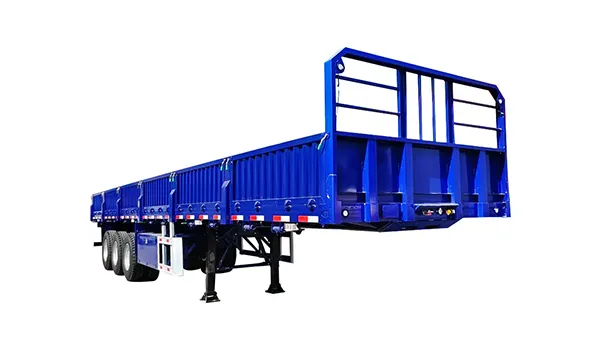
We also manufacture flatbed, skeleton, sidewall, fence, tanker, cement tanker, dump, car carrier, and other heavy-duty transport trailers.
Our aim is not to make every customer buy the same semi lowboy.
We first understand what you need to move. Then we match the frame, axle system, deck, loading system, and tractor interface to the project.
For fleet owners, equipment rental companies, mining operations, construction contractors, and distributors, that approach can make long-term operation much more predictable.
FAQ
À quoi sert une remorque surbaissée ?
A lowboy trailer is mainly used to transport heavy or tall machinery such as excavators, bulldozers, loaders, pavers, mining equipment, and industrial machines. Its low deck helps reduce the total loaded height and center of gravity.
Quelle est la différence entre une remorque surbaissée et une remorque RGN ?
A conventional lowboy normally loads equipment using rear ramps. An RGN trailer has a detachable front gooseneck that allows equipment to drive onto the trailer from the front. RGN stands for removable gooseneck.
Is a lowboy trailer the same as a lowbed trailer?
The terms are often used for closely related heavy-equipment trailers. “Lowboy” is especially common in North America, while “lowbed” is widely used in international markets. Exact structures still vary by manufacturer and region.
What is the difference between a fixed-neck lowboy and a removable gooseneck?
A fixed-neck lowboy keeps the front neck permanently connected to the trailer structure. A removable-gooseneck design allows operators to detach the front neck and create a front loading path. The RGN is usually more convenient for large crawler equipment.
Can a lowboy trailer carry 55 tons?
A suitably engineered lowboy may be configured around a 55 ton payload requirement, but trailer capacity cannot be confirmed by one number alone. Axle ratings, frame design, equipment position, tractor configuration, road rules, and legal gross weight must also be checked.
Can I use a lowboy trailer for a pickup truck?
A heavy industrial lowboy trailer for pickup truck is generally a different product class from the semi-trailer lowboys discussed here. CHENLU’s lowboy products are designed primarily for tractor units and heavy commercial equipment transport. Pickup-towed equipment trailers use different coupling, braking, weight, and structural requirements.




 3 septembre 2026