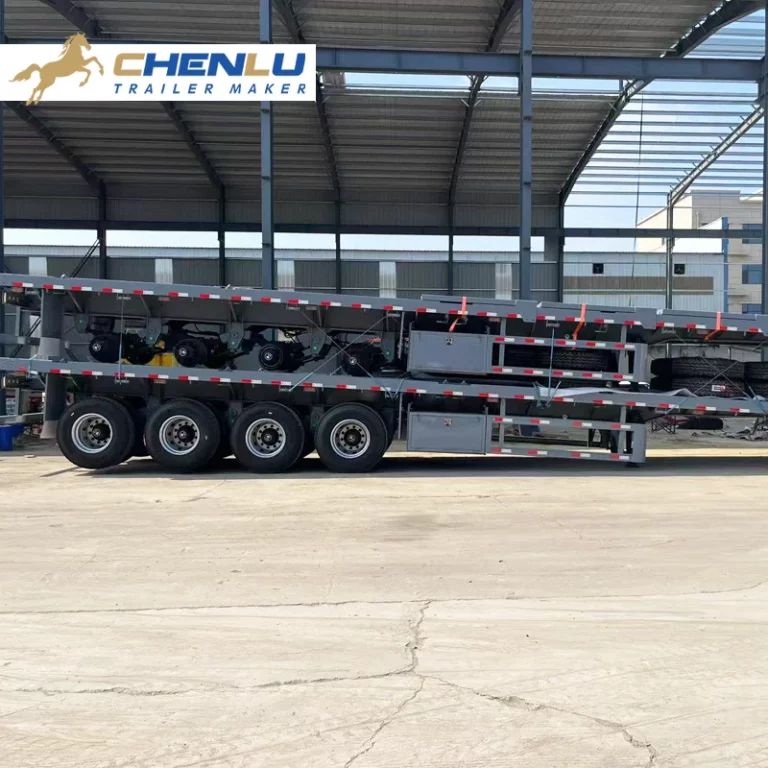
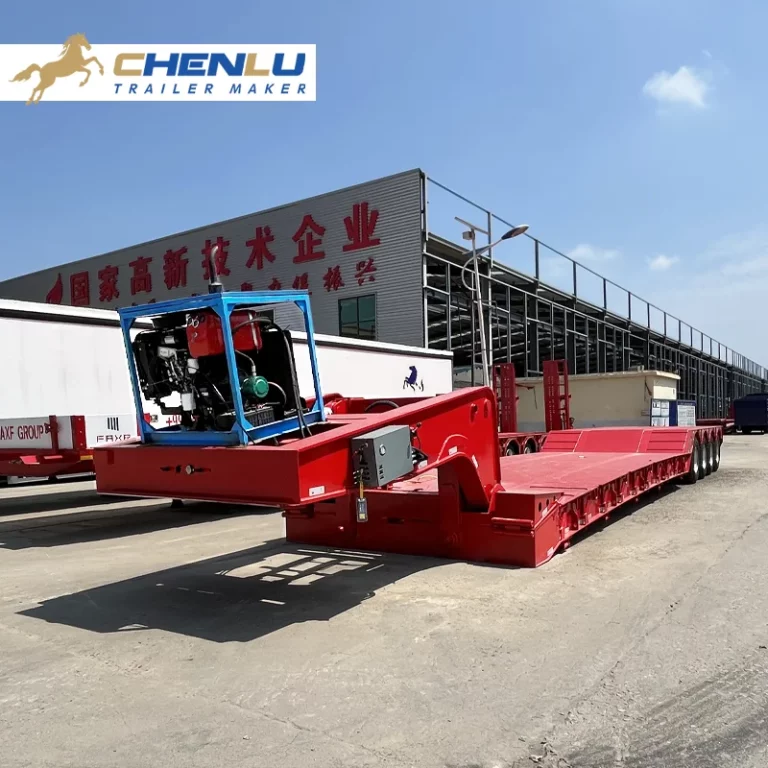
Heavy cargo is hard to move. A tall machine can break height rules, delay jobs, and create safety risks. A well-built lowboy trailer solves this with a lower deck, safer loading, and strong structure for serious transport work.
A lowboy trailer is a heavy-duty semi-trailer with a dropped main deck. It is used to haul heavy equipment, oversized machinery, bulldozers, mining machines, and construction cargo while keeping total height and center of gravity lower than many standard transport options.
Article outline: This guide explains what a lowboy is, how the deck works, common designs, lowboy trailer dimensions, loading methods, RGN choices, buying checks, compliance points, and OEM / ODM customization ideas for global fleet buyers.

Guia de reboques de plataforma baixa: Como escolher o reboque de plataforma baixa certo para o transporte de cargas pesadas
O que é um reboque «lowboy» e por que razão é utilizado para transportar equipamento pesado?
A reboque rebaixado is a type of trailer with two drops in deck height. One drop sits after the front neck area, and the other sits before the wheel area. These drops create a low deck, so tall machines can travel with better height control.
This trailer is used to transport cargo that is too tall, too heavy, or too hard to place on a standard flatbed. In export projects, buyers often use it for excavators, wheel loaders, road rollers, transformers, heavy machinery, and mining support machines. The trailer bed stays low to the ground, so the load has a lower center of gravity.
For fleet owners and contractors, the value is simple. A lowboy trailer can haul equipment that a flatbed trailer cannot handle well. It helps reduce height risk, improves loading safety, and gives the buyer more room to match local roads, permits, and job-site needs.
How Does the Deck Improve Heavy Haul Safety?
The deck is the working heart of the unit. A lower deck height keeps tall cargo closer to the road. This matters because high cargo catches more wind, leans more in turns, and can place extra stress on the tractor and frame.
A strong deck spreads weight across the main beams, cross members, suspension, and axle group. Buyers should not judge only by paint. Check steel grade, beam structure, welding quality, cross-member spacing, kingpin area, landing gear area, and tie-down points.
From a manufacturer’s view, this is where OEM / ODM design matters. A contractor may need a reinforced deck for crawler machinery. A mining company may need thicker wear plates. A port logistics buyer may care more about easy service and stable daily use. The right deck design helps the whole fleet work with fewer problems.
What Type of Lowboy Trailer Should You Choose?
There is more than one type of lowboy trailer. The best choice depends on cargo weight, cargo height, road rules, loading method, tractor power, and how often the buyer moves heavy loads. In simple terms, lowboys are not “one design fits all.”
| Tipo |
Ideal para |
Vantagem principal |
Buyer Note |
| Pescoço de ganso fixo |
Regular heavy cargo routes |
Strong, simple, lower cost |
Often needs rear ramps |
| Fixed-neck lowboy |
Repeat jobs with similar cargo |
Durable front structure |
Less flexible for front access |
| Detachable gooseneck lowboy |
Self-moving heavy equipment |
Carregamento frontal mais fácil |
Higher cost, faster site work |
| Reboque RGN |
Oversized project cargo |
Direct front access |
Good for construction and mining fleets |
| Hydraulic detachable |
Frequent loading and unloading |
Can raise and lower the trailer |
Needs good service planning |
A detachable gooseneck lowboy trailer lets the front section separate, so equipment can be driven from the front onto the trailer. This helps when moving a crawler excavator, bulldozer, or heavy machinery that should not climb steep rear ramps.
RGN, Removable Gooseneck, and Detachable Gooseneck: What Is the Difference?
Many buyers ask about rgn, removable gooseneck, and detachable gooseneck. In daily market language, these terms often point to the same basic idea: the front neck separates from the main deck for loading. This makes the deck of a lowboy become a direct access path.
An rgn trailer is usually a premium choice for lowboy transport. After the machine is placed, the front neck connects again and becomes attached to the trailer for road movement. This design is common in heavy haul work because it gives better access for self-moving machines.
For buyers comparing gooseneck lowboy trailers, the key is not only the name. Check the locking system, cylinders, hoses, neck structure, welding, and ease of service. A hydraulic detachable system can save time, but it should fit the customer’s climate, road dust, operator habits, and spare parts plan.

Guia de reboques de plataforma baixa: Como escolher o reboque de plataforma baixa certo para o transporte de cargas pesadas
What Are Common Lowboy Trailer Dimensions?
Lowboy trailer dimensions change by market, cargo, and regulation. Common deck length can range from about 20 feet to over 30 feet, while full length may be much longer because of the front neck, rear bridge, and axle setup. Many buyers ask, “How long is a lowboy trailer?” The honest answer is: it depends.
| Item |
Common Range or Question |
Porque é que é importante |
| Main deck length |
Often 20–30+ ft |
Must fit machine tracks or cargo footprint |
| Altura do convés |
Often around 18 to 24 inches on many designs |
Helps control total loaded height |
| Largura |
Designed around local road limits |
Wider cargo may need permits |
| Configuração do eixo |
2, 3, 4, or multi-axle options |
Affects payload and legal road use |
| Carga útil |
25-ton lowboy, 35-ton lowboy, 50-ton+ options |
Must match real working load |
Exact dimensions should be confirmed before production. The dimensions of a lowboy trailer should match the cargo list, route, tractor model, tire choice, suspension, number of axles, and maximum dimensions allowed by local rules.
For U.S.-related planning, the FHWA Commercial Vehicle Size and Weight Program gives useful background on federal weight and width standards, while height rules are often set by states. Export buyers should always confirm their own market rules before selecting trailer dimensions.
How Does Loading Work on a Lowboy?
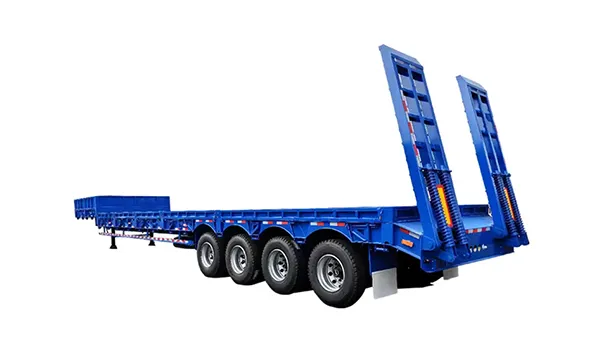
Loading is one of the biggest reasons buyers choose this trailer type. On a fixed front-neck design, the machine usually moves from the rear with ramps. On a detachable model, the front neck is removed, the deck is placed for access, and the machine drives forward onto the trailer.
This makes loading safer for many heavy equipment jobs. A lower approach angle reduces stress on the machine, improves operator control, and helps protect the deck. Good loading design can save time every day, especially when a fleet must load and unload at many job sites.
As a trailer manufacturer, we look at the buyer’s real cargo before we suggest a loading system. A crawler excavator, grader, and wheel loader do not behave the same way. Their track width, ground clearance, center of gravity, and contact area all affect trailer design.
Lowboy Trailer vs Flatbed, Step Deck, and Double Drop: Which Is Better?
A standard flatbed is simple and useful for steel, pipes, building materials, and general cargo. But standard flatbed trailers sit higher, so they are not ideal for tall heavy machines. A step deck trailer has a drop deck, which gives more height room than a flatbed, but it may not be low enough for some heavy work.
A double drop design is closer to a lowboy in purpose. It has a lower center section for taller loads. The feature of a lowboy is that it uses a very low main platform and strong heavy-duty structure for oversized and concentrated loads. Lowboy trailers come in many trailer configurations, so buyers can choose fixed neck, neck lowboy, or detachable gooseneck trailer options.
| Trailer types |
Better For |
Simple Buyer Rule |
| Plataforma |
Carga geral |
Choose it when cargo is not too tall |
| Plataforma escalonada |
Carga de altura média |
Choose it when extra height room is enough |
| Double drop |
Carga alta |
Choose it when the middle section must be lower |
| Standard flatbed vs lowboy |
General freight vs low machine transport |
Use the lowboy when height and weight are the problem |
How to Choose the Right Lowboy Trailer for Your Fleet?
To choose the right lowboy trailer, start with the cargo, not the catalog. List your heaviest machine, tallest machine, longest machine, and most common route. Then match the unit with real work conditions.
Buyers should check these points:
- Payload and structure: Do you need a 25-ton, 35-ton, or higher ton lowboy?
- Deck and beam design: Is the platform strong enough for concentrated track pressure?
- Front neck design: Do you need fixed gooseneck lowboys or detachable gooseneck lowboy trailers?
- Axle layout: Does the spacing match road rules and bridge limits?
- Loading method: Can the team load and unload safely at the job site?
- Export details: Are lights, kingpin, landing gear, tires, paint, and brake system suitable for your market?
This is where a factory-direct partner can help. We build lowboy trailers for sale with OEM / ODM options for fleet owners, trailer distributors, project buyers, construction contractors, mining companies, and heavy equipment rental businesses. We help buyers select the right trailer for route, cargo, budget, and service plan.
What Should Buyers Check Before Buying Lowboy Trailers for Sale?
A smart purchase begins with a clear specification sheet. Do not ask only for price. Ask for steel thickness, main beam size, deck plate material, suspension type, tire option, brake system, paint process, electrical system, and drawing confirmation.
For international buyers, factory communication is also important. A lowboy truck combination must match the tractor’s fifth wheel height, engine power, legal load, and road condition. The trailer must also fit port shipping limits and customs documents. A good manufacturer should help with drawings, photos, production updates, packing advice, and after-sales parts.
Case example: A mining contractor needed a lowboy trailer used for shipping crawler equipment between remote sites. Roads were rough, and loading happened in dusty areas. We suggested reinforced structure, practical hydraulic detachable options, and an axle layout based on planned payload. The goal was not just to sell a trailer. The goal was to keep the project moving.

Guia de reboques de plataforma baixa: Como escolher o reboque de plataforma baixa certo para o transporte de cargas pesadas
What Regulations and Securement Rules Affect Lowboy Transport?
Lowboy transport often involves oversized cargo, so regulations matter. Road width, height, gross weight, axle load, route permits, escorts, lighting, signs, and securement rules can all affect the final design. A buyer should never treat a catalog dimension as a legal answer.
In the United States, FHWA explains federal standards for weight and width on certain highways, while states handle many height limits. For heavy vehicles and machinery over 10,000 lb, 49 CFR § 393.130 covers securement rules, including restraint against movement and minimum tiedown requirements for many heavy machines. Other countries have their own rules, so local checks are always needed.
Good engineering reduces risk. The design should support legal payload, safe weight spread, practical tiedown points, and stable road behavior. But the operator must still inspect the load, secure it correctly, and follow local transport rules.
Why Work With a China Lowboy Semi-Trailer Manufacturer?
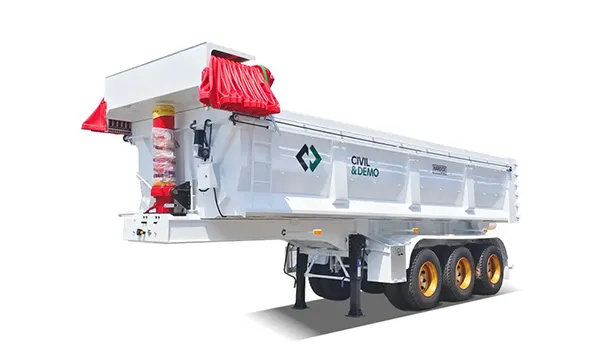
A professional China trailer manufacturer can give buyers more flexibility in design, cost, and delivery planning. We specialize in flatbed semi trailers, skeleton container trailers, side curtain trailers, fence trailers, lowbed trailers, lowboy trailers, removable neck models, tankers, dump semi trailers, trucks, and trailer parts.
For lowboy projects, we can support OEM / ODM choices such as deck length, beam structure, axle brand, suspension, tires, brake system, hydraulic system, paint color, tool box, spare tire carrier, ramps, and local compliance details. This helps distributors and fleet buyers offer the right equipment in their market instead of forcing one standard model on every customer.
Our main advice is simple: share your cargo list early. Send machine model, machine weight, machine size, route condition, expected payload, working country, and preferred tractor. With this information, we can recommend a practical lowboy trailer guide plan and help you avoid over-buying or under-specifying.
FAQs About Lowboy Trailers
Para que é utilizado um reboque lowboy?
Lowboy trailers are used to haul tall, heavy, and oversized machinery. Common cargo includes excavators, bulldozers, wheel loaders, graders, drilling machines, transformers, and industrial project cargo.
Qual é a diferença entre um reboque lowboy e um reboque lowbed?
In many markets, “lowboy” and “lowbed” are used in similar ways. Both describe a semi-trailer with a low main deck. Some buyers use “lowboy” more often in North America, while “lowbed” is common in many export markets.
Can a lowboy carry containers?
It can carry some project cargo and container-like loads when designed for that purpose, but a skeleton trailer or general platform model is usually better for regular container transport. A lowboy is mainly designed to haul heavy machinery and tall equipment.
How long is a lowboy trailer?
The answer depends on the model. Main deck length may be around 20 to 30+ feet, while total length depends on front neck, rear bridge, and axle layout. Always confirm exact dimensions with the manufacturer before ordering.
Is a hydraulic detachable neck worth it?
Yes, if you load heavy self-propelled equipment often. It can improve front loading and reduce job-site time. For rare loading work, a fixed front-neck model may be more cost-effective.
What information should I send to get a quote?
Send cargo weight, cargo size, photos, loading method, road condition, destination country, required payload, tractor model, and preferred accessories. This helps the manufacturer design the right trailer instead of giving a rough price only.
Principais conclusões
- A lowboy trailer has a low deck that helps carry tall and heavy cargo.
- It is often the right choice when you need to haul heavy machines with better height control.
- The main deck, neck design, axle layout, and loading method decide real performance.
- RGN and removable front-neck designs make front loading easier for heavy equipment.
- A trailer with two deck drops gives better height control than many general cargo options.
- Lowboy trailer dimensions should match cargo, route, local laws, and tractor setup.
- Low deck height is useful, but it must still match real payload, route limits, and safe structure.
- A first lowboy trailer purchase should start with cargo data, not only price.
- A common lowboy mistake is buying too light, too short, or too hard to service.
- Buyers should check structure, welding, deck strength, hydraulic parts, and compliance details.
- OEM / ODM customization helps fleet owners, distributors, contractors, and mining companies get a better long-term transport solution.




 23 de junho de 2026