CHENLU Engineering Team | Updated October 2026
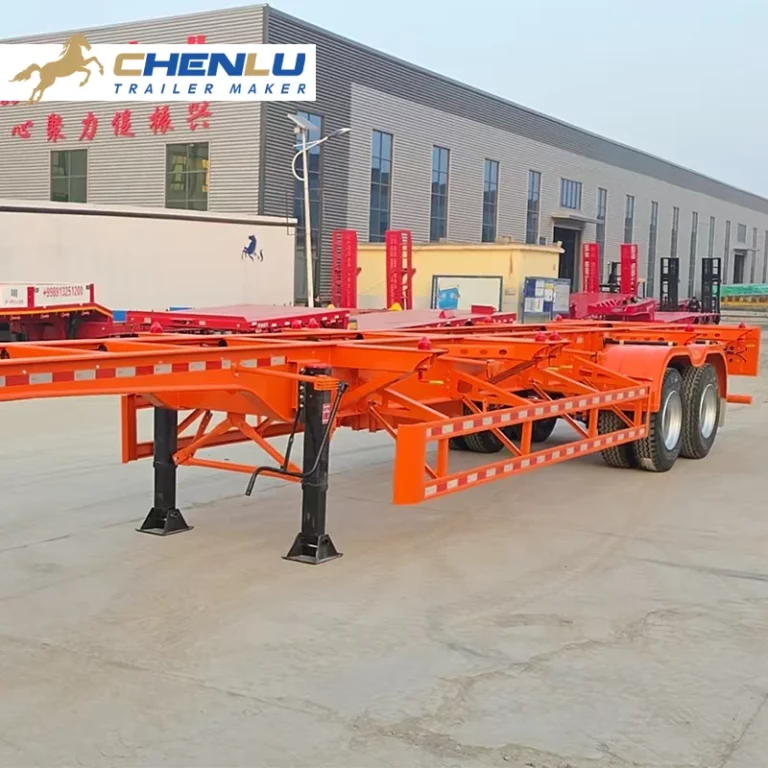
Quick answer: A container chassis, also called a skeleton or skeletal trailer, is a semi-trailer frame without a deck, fitted with twist locks that lock onto the corner castings of an ISO shipping container. Because it has no deck, it is lighter than a flatbed, so more of the legal weight limit goes to cargo. It carries containers only.
How a container chassis works
The chassis is built from two main longitudinal beams joined by cross members. Twist locks sit at the points where container corners rest. The container is lifted on by a crane or reach stacker, lowered onto the locks, and the locks are turned to hold it in place. The container itself becomes the load-carrying body.
Main parts of a container chassis
| Part |
Function |
| Main beams |
Carry the load; high-strength steel keeps weight down while resisting twisting |
| Twist locks |
Lock the container’s corner castings to the chassis |
| Kingpin |
Couples the chassis to the tractor’s fifth wheel (2″ or 3.5″) |
| Landing gear |
Supports the front when the chassis is uncoupled |
| Axles and suspension |
Carry the load to the road; leaf spring suspension is common |
Types of container chassis
- 20 ft chassis: short wheelbase for single 20 ft containers and tight port yards.
- 40 ft chassis: carries one 40 ft or two 20 ft containers, the most common size.
- Extendable or 45 ft chassis: adjusts to different container lengths.
- Tipping chassis: lifts the container to unload bulk cargo through its rear doors.
- Gooseneck chassis: a lowered front section lets taller containers sit lower.
These are general industry types. Ask us which configurations we can build for your containers.
CHENLU 2 axle skeleton trailer: specifications
| Item |
Specification |
| Max payload |
30 T |
| Containers |
20 ft and 40 ft (45 ft on request) |
| Axles |
2 × 13T FUWA |
| Suspension |
Leaf spring |
| Twist locks |
12 |
| Landing gear |
JOST E100 |
| Kingpin |
2″ (50 mm) or 3.5″ (90 mm) JOST |
| Size |
To buyer’s request |
| Warranty |
2 years |
The short wheelbase gives a tight turning radius for port work. See the 2 Axle Skeleton Trailer page for photos and video.
Container chassis vs flatbed trailer
|
Container chassis (skeleton) |
Flatbed trailer |
| Deck |
No deck, frame and twist locks only |
Full flat deck plus twist locks |
| Cargo |
ISO containers only |
Containers, steel, machinery, bulk goods |
| Tare weight |
Lowest |
Higher |
| Best for |
Ports and dedicated container fleets |
Mixed cargo and return loads |
If your trucks return empty after delivering a container, a flatbed lets you carry other cargo on the way back. If you only move containers, the lighter chassis carries more payload. Read more in Flatbed Trailer vs Skeleton Trailer.
Container chassis FAQ
Is a container chassis the same as a skeleton trailer?
Yes. Container chassis, skeleton trailer and skeletal trailer all describe a deckless semi-trailer frame with twist locks for ISO containers.
How much can a container chassis carry?
The CHENLU 2 axle skeleton trailer has a maximum payload of 30 T. Heavier containers need more axles; the legal payload depends on your road limits.
How many twist locks does a container chassis need?
Four locks hold one container. A 40 ft chassis that also carries two 20 ft containers needs more positions; the CHENLU skeleton trailer has 12.
Can a container chassis carry loose cargo?
No. It has no deck. For loose cargo, use a flatbed or sidewall trailer.
What size container chassis do I need?
Match the chassis to your containers: 20 ft, 40 ft (or two 20 ft), or 45 ft. Tell us your container mix and we will recommend the length and axle count.
Order a container chassis
Compare skeleton and flatbed options on our flatbed and container trailer page, or contact us with your container sizes and route. Pricing is factory-direct and confirmed on inquiry.




 21 October 2026