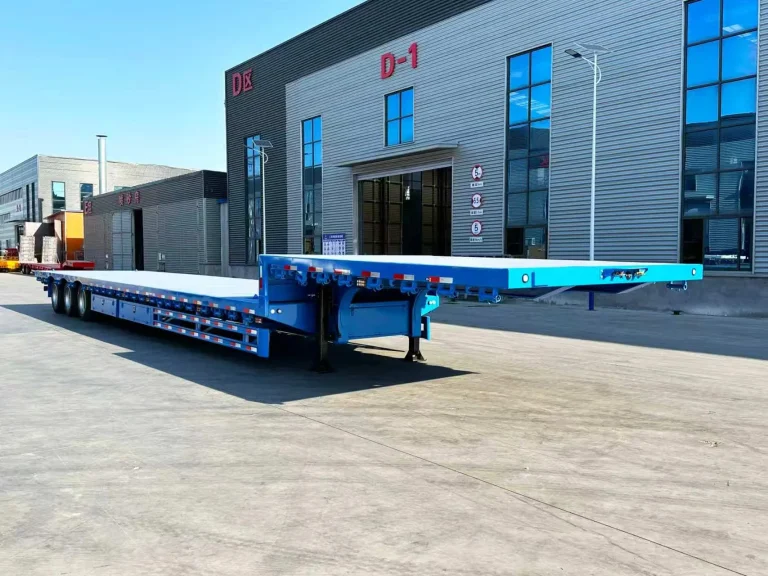
Heavy machinery transport in African markets often involves long distances, uneven roads, construction sites, mining areas, and different local vehicle regulations. A standard trailer configuration may not fit every project. For this reason, CHENLU recently completed a batch of customized 3 axle lowbed semi trailers for customers in African markets.
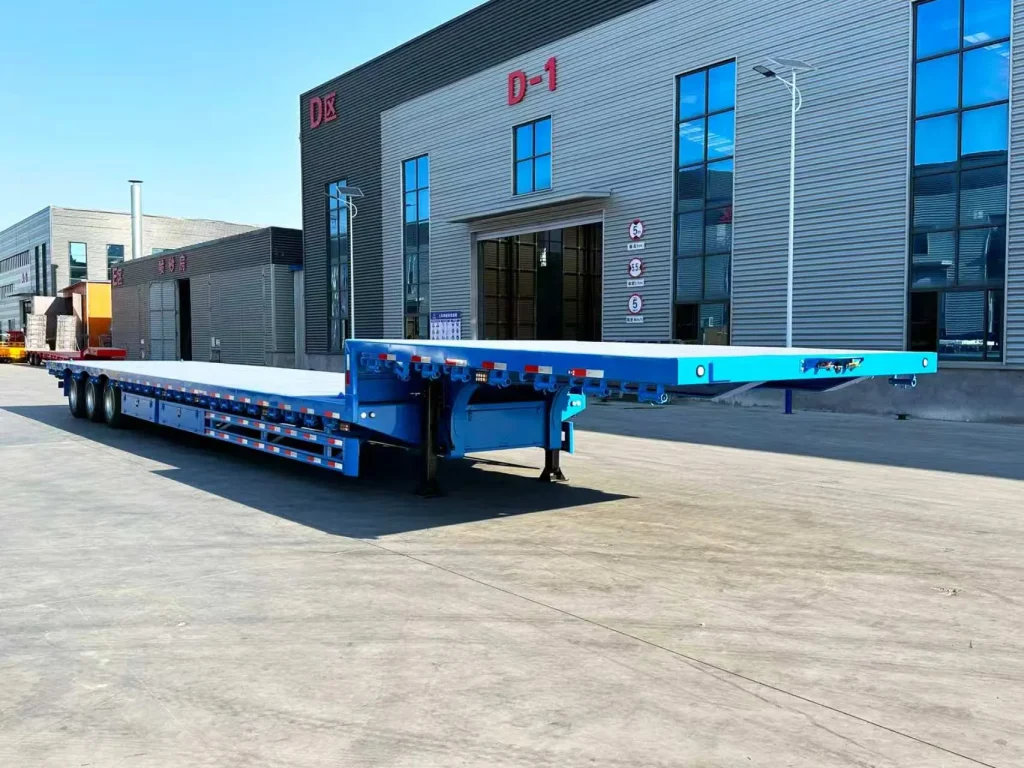
These trailers use a low cargo platform, three-axle running gear, a reinforced open deck, multiple cargo securing points, and practical side storage. The configuration is designed around heavy equipment and industrial cargo transport while allowing customers to adapt the final specification to their local operating conditions.
4 Axle Lowbed Trailer Designed for Heavy Transport
The main feature of this customized trailer is its low loading platform.
Compared with a standard flatbed semi trailer, the lower deck helps reduce the overall loaded height when carrying construction machinery, industrial equipment, or other tall cargo. A lower center of gravity can also support more stable transport when the trailer is properly loaded and operated.
CHENLU currently positions its lowbed trailer range for machinery such as excavators, bulldozers, loaders, mining machines, and other heavy equipment. The company also offers three-axle and four-axle lowbed configurations for different transport requirements.
Typical applications can include:
- Excavators
- Wheel loaders
- Bulldozers
- Road construction machinery
- Agricultural machinery
- Matériel minier
- Industrial components
- Large project cargo
The exact permitted payload must be determined according to the final chassis, axle configuration, tires, tractor, road regulations, and destination market.
Why Use a Four-Axle Configuration?
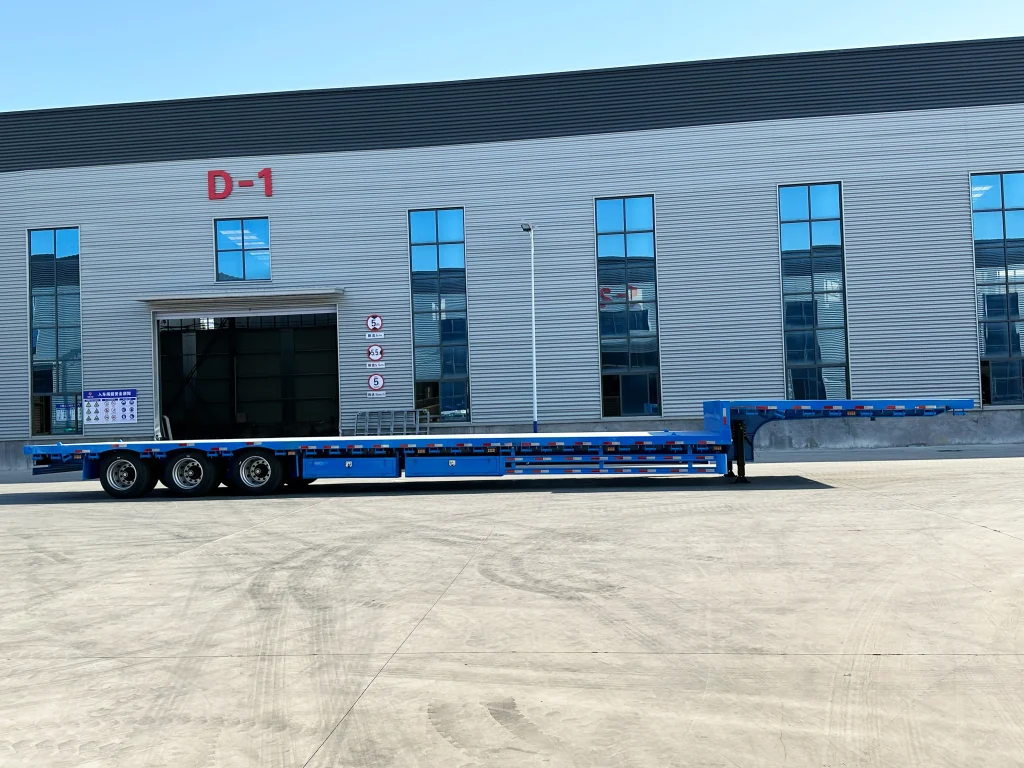
The photographs clearly show a three-axle rear group.
A four-axle layout is widely used for lowbed semi trailers because it can provide a practical balance between load distribution, vehicle length, maneuverability, and operating cost.
However, axle quantity alone does not define the trailer’s carrying capacity. The full design must consider:
- Capacité de l'essieu
- Entraxe
- Tire capacity
- Système de suspension
- Main beam structure
- Charge du pivot
- Caractéristiques techniques du tracteur
- Limites légales de charge par essieu
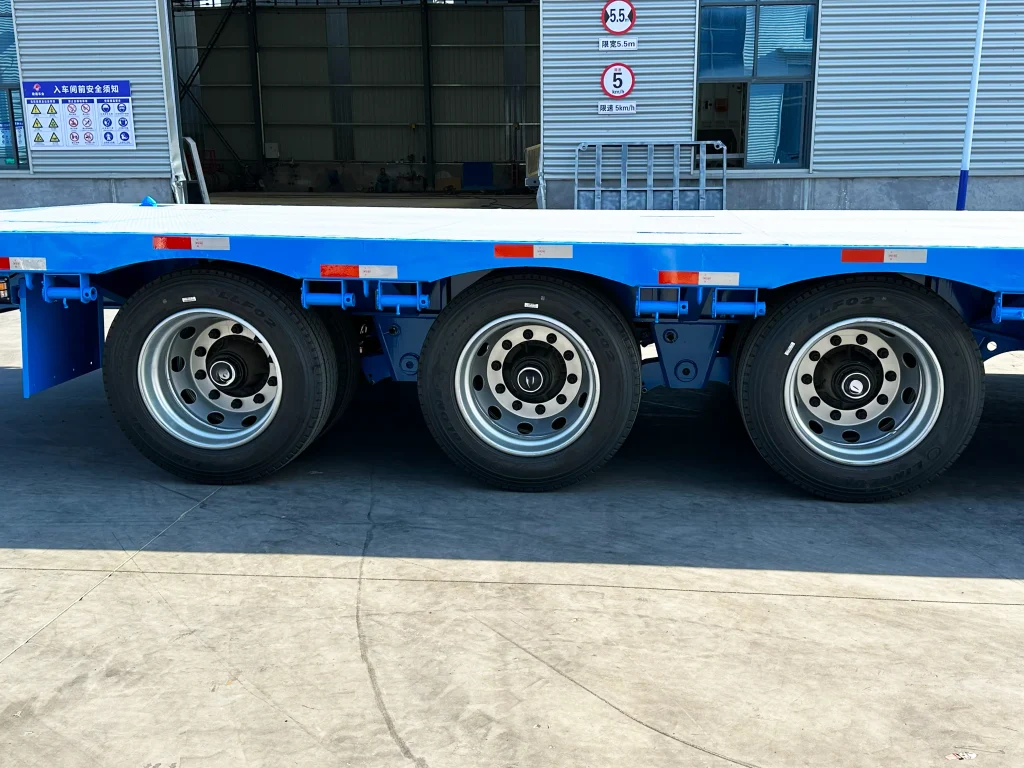
CHENLU’s current 3 axle lowbed product uses mechanical suspension and high-strength steel construction, with the product positioned for complex road conditions and heavy-equipment transport.
For export orders, the axle arrangement can be discussed according to the customer’s country and actual operating conditions.
Low Deck Helps Control Overall Transport Height
Tall machinery creates a common problem in heavy transport: once the machine is placed on the trailer, the total vehicle height may become too high for bridges, power lines, tunnels, or local transport rules.
A semi-remorque surbaissée places the main loading deck lower than a standard flatbed. This gives fleets more usable vertical space for tall equipment.
For contractors and equipment rental companies, the design can be useful when moving:
-
- Excavators between project sites
- Loaders between mines and workshops
- Construction machines between cities
- Industrial equipment to infrastructure projects
CHENLU’s machinery transport range specifically uses low-deck trailers to reduce loading height for heavy equipment applications.
Open Platform Supports Flexible Cargo Loading
Unlike the previous lowbed trailer project with rear loading ramps, the trailer shown in these photos uses a clean open loading platform without visible rear ramps.
This configuration can be suitable when cargo is loaded with:
- Cranes
- Forklifts
- External loading ramps
- Project-site lifting equipment
The long open deck also gives operators flexibility when positioning machinery or industrial cargo of different lengths.
This is important for project buyers who do not always move the same machine. A trailer may need to carry construction equipment on one trip and industrial components on another.
Multiple Tie-Down Points for Cargo Securing
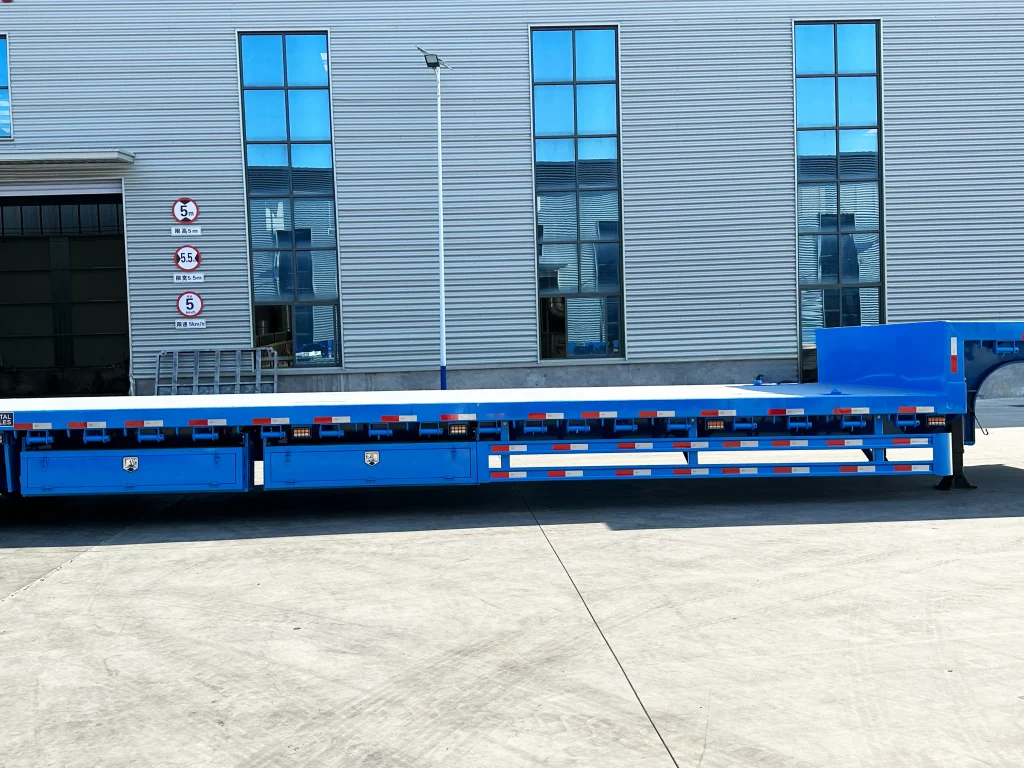
The side of the trailer includes multiple visible cargo securing points distributed along the deck.
These points give operators more options when positioning chains, straps, or other suitable restraint equipment around different cargo shapes.
Heavy equipment does not always have the same fixing points. An excavator, loader, steel structure, and industrial machine may each require a different securing arrangement.
For OEM projects, CHENLU can discuss:
- D-rings
- Lashing rings
- Rope hooks
- Chain fixing points
- Reinforced securing positions
- Additional restraint accessories
The final restraint method should always match the actual cargo and applicable local transport regulations.
Practical Toolboxes and Side Protection
The trailer photographs also show integrated side toolboxes and side protection structures.
For daily fleet operation, these details are useful because drivers may need storage space for:
Chains
Straps
Tools
Gloves
Maintenance equipment
Small spare parts
Cargo securing accessories
Toolbox position, size, and quantity can be adjusted according to the customer’s requirements.
The side protection structure can also be configured according to destination-market regulations and fleet preferences.
Built for Different African Operating Conditions
Africa is not one single transport environment.
Road quality, climate, axle regulations, cargo type, fuel availability, and maintenance conditions differ greatly between countries and regions.
CHENLU’s website states that its machinery and equipment transport trailers are supplied for demanding markets including Africa, South America, and Central Asia, while its products overall have been exported to more than 30 countries.
For African projects, buyers may need to consider:
| Operating Condition |
Trailer Design Focus |
| Rough roads |
Frame and suspension durability |
| Long-distance routes |
Stable axle and tire configuration |
| Engins de chantier |
Low deck and reinforced structure |
| Remote sites |
Components that are practical to maintain |
| Construction projects |
Flexible loading and cargo securing |
| Mining operations |
Strong chassis and repeated loading capability |
CHENLU has also previously supplied three-axle and multi-axle lowbed trailers to customers in Nigeria, Tanzania, and other African markets for heavy machinery and industrial transport.
OEM and ODM Lowbed Trailer Customization
For overseas customers, CHENLU does not limit lowbed production to one fixed configuration.
As a professional semi trailer manufacturer in China, CHENLU supports OEM and ODM customization according to cargo, local roads, transport regulations, and fleet requirements. Its website lists customized trailer engineering as a core service for international markets.
Lowbed trailer customization can include:
- Overall trailer dimensions
- Platform length and width
- Hauteur du pont
- Nombre d'essieux
- Axle rating and brand
- Mechanical or other suspension options
- Main frame reinforcement
- Configuration des pneus et des jantes
- Pied de support
- Cargo securing points
- Boîtes à outils
- Side protection
- Spare tire carriers
- Paint color
- Customer logo
- Other project-specific accessories
For a more accurate configuration, customers should provide their cargo information before production.
The most useful details are:
Machine type + machine dimensions + operating weight + destination country + road conditions + tractor specification + preferred trailer configuration
Quality Control Before Export
A heavy-equipment trailer must do more than look good in factory photographs.
Structural fabrication, welding quality, axle installation, suspension alignment, brakes, electrical systems, landing gear, tires, and final dimensions all affect long-term operation.
CHENLU states that its manufacturing process covers raw material processing through final assembly, with factory production and quality control carried out at its own manufacturing base.
For international projects, production photos and videos can also help customers follow the order before shipment.
Key inspection points may include:
- Main chassis
- Welded joints
- Axle and suspension installation
- Système de freinage
- Système électrique
- Cargo securing points
- Pied de support
- Tires and rims
- Surface finish
- Final dimensions
Supporting Construction, Mining and Infrastructure Projects
Lowbed trailers are an important part of CHENLU’s broader heavy transportation product system.
Besides 3 axle lowbed semi trailers, the machinery transport range includes:
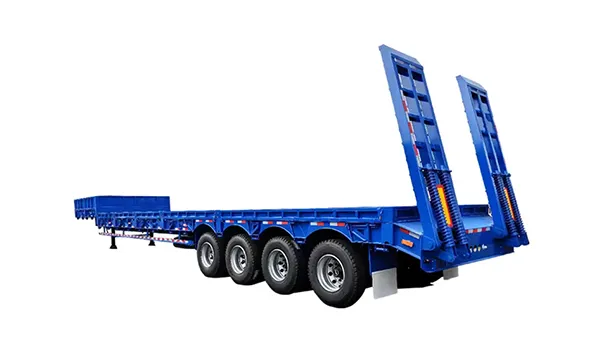
- 4 Axle Lowbed / Lowboy Trailer
- Multi Axle Lowbed Trailer
- Remorque pliante à col de cygne
- Remorque amovible à col de cygne
- Hydraulic Ramp Lowbed Trailer
- Customized Heavy Equipment Trailer
Different designs suit different loading methods and machinery types. CHENLU’s machinery transport catalog positions lowbed and gooseneck trailers for excavators, bulldozers, loaders, mining equipment, transformers, infrastructure equipment, and oversized industrial cargo.
Customized for the Job, Not Just the Model Name
This batch of 3 axle lowbed semi trailers customized for African customers shows an important point in heavy transport: the right trailer should start with the operating job.
Axle quantity is only one part of the design.
The deck height, chassis, suspension, tires, cargo securing points, storage accessories, destination regulations, and road conditions all need to work together.
If you are transporting excavators, construction machinery, mining equipment, industrial components, or other heavy cargo, send CHENLU your cargo dimensions, operating weight, destination country, road conditions, and preferred configuration.
Our engineering team can develop a factory-direct lowbed trailer solution based on your project requirements.




 22 September 2026