Heavy machinery transport becomes difficult when the trailer deck is too high, the loading angle is too steep, or the running gear does not match the equipment weight. This newly completed 3 axle gooseneck lowbed trailer gives equipment fleets a lower, more practical platform for machinery transport.
This shipment is a 3 axle fixed-gooseneck lowbed semi trailer built for heavy equipment transport. It combines a low loading deck, three rear axles, mechanical suspension, and twin rear loading ramps. The fixed gooseneck structure suits excavators, loaders, bulldozers, and other machines that can be loaded from the rear.
Project Overview
This 3 axle lowbed trailer has completed production and entered the shipment stage at the CHENLU factory.The finished trailer uses a white exterior, a low main loading platform, a fixed front gooseneck, three rear axles, and two large rear ramps. The shipment photos show the trailer from the front, side, rear, and gooseneck area, giving buyers a clear view of its overall structure before delivery.
| Item |
Shipment Information |
| Product |
3 Axle Gooseneck Lowbed Trailer |
| Trailer Type |
Fixed-gooseneck lowbed semi trailer |
| Axles |
3 |
| Loading Method |
Rear loading |
| Rear Ramps |
Twin mechanical ramps |
| Suspension |
Mechanical suspension |
| Main Application |
Heavy equipment transport |
| Typical Cargo |
Excavators, loaders, bulldozers, construction machinery |
| Exterior |
White |
| Shipment Status |
Ready for shipment |
The exact rated payload and final dimensions of this customer order are not disclosed here. CHENLU’s current 3-axle lowbed product range publishes 30–60 tons as a reference capacity range, while the individual product page describes capacity up to 60 tons. Final capacity should always follow the approved order specification.
What Type of Trailer Is Being Shipped?
This trailer is best described as a:
3 Axle Fixed Gooseneck Lowbed Semi Trailer
The word fixed gooseneck is important.
On this design, the front gooseneck remains connected to the main trailer frame. Heavy machinery is loaded from the rear over the ramps instead of entering from the front.
CHENLU currently classifies fixed-gooseneck lowbeds as the standard lowboy structure for construction equipment that can climb rear ramps. Compared with a removable gooseneck, the fixed design is mechanically simpler and requires less hydraulic equipment at the front connection.
This makes the design well suited to fleets that regularly move:
- Excavators
- Wheel loaders
- Bulldozers
- Road construction machinery
- Agricultural machinery
- Industrial equipment
- Other heavy wheeled or tracked machines
Why Does the Low Deck Matter for Heavy Equipment Transport?
The central feature of a lowbed semi trailer is not simply its capacity. It is the height of the main loading deck.
Placing the machine lower helps reduce the loaded vehicle’s overall height and keeps the equipment’s center of gravity closer to the road.
That matters when transporting machines with:
- Tall cabs
- Booms
- Rollover protection structures
- Large tires
- High upper frames
- Fixed attachments
CHENLU’s current lowbed product page explains that the lowbed structure reduces loading height and makes the loading, unloading, and transportation of construction machinery and heavy cargo more practical.
For buyers, this creates a simple selection rule:
Machine height + trailer deck height = loaded transport height.
Before ordering, both numbers should be checked against bridges, power lines, tunnels, local road rules, and project-site access.
Why Use Three Axles on a Lowbed Trailer?
The three-axle running group is one of the most common configurations for general heavy equipment transport.
Three axles help distribute trailer and equipment weight across more wheel positions than a two-axle design. They also provide a practical balance between load support, trailer length, maneuverability, tire count, and maintenance.
However, axle count alone does not determine how much a trailer can safely or legally carry.
The final rating also depends on:
- Equipment transport weight
- Equipment center of gravity
- Position of the machine on the deck
- Axle rating
- Axle spacing
- Tire rating
- Tractor configuration
- Local axle-load laws
- Road and bridge restrictions
CHENLU currently publishes 30–60 tons as the reference range for its standard 3-axle lowbed family. Buyers should treat that as a product-family reference rather than assume every three-axle trailer has the same rated payload.
For an accurate quotation, the machine model and real transport weight should come first.
How Do the Rear Ramps Help With Loading?
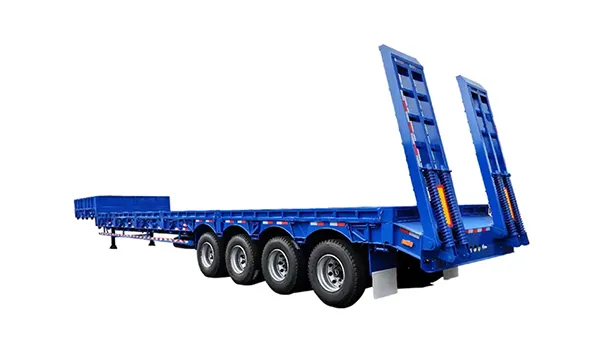
The shipment photos show two tall rear loading ramps.
These allow self-propelled machinery to approach the trailer from the rear and drive onto the low loading deck.
The visible spring assemblies on the ramps provide mechanical assistance during ramp movement. This type of arrangement is useful when the operator wants a relatively simple loading system without depending on a detachable front gooseneck.
[Image Placeholder: Rear View of Twin Mechanical Loading Ramps]
A practical rear-ramp system should be selected according to:
- Machine ground clearance
- Track or tire size
- Ramp length
- Loading angle
- Machine weight
- Site surface
- Loading frequency
A crawler excavator with limited ground clearance may need a gentler loading angle than a wheeled loader.
This is why CHENLU also offers different loading concepts across its heavy-equipment trailer range, including mechanical ramps, hydraulic ramps, and removable-gooseneck designs.
Fixed Gooseneck or RGN: Which Design Is Better?
Both can transport heavy machinery, but they solve different loading problems.
| Feature |
Fixed Gooseneck Lowbed |
RGN Lowbed |
| Gooseneck |
Permanently connected |
Detachable |
| Loading |
Rear ramps |
Front loading |
| Hydraulic neck system |
Not required |
Usually required |
| Structure |
Simpler |
More complex |
| Maintenance |
Lower complexity |
More components |
| Best for |
Machines that can climb ramps |
Low-clearance / difficult-to-load machines |
FAQ
What is a 3 axle fixed gooseneck lowbed trailer?
A 3 axle fixed gooseneck lowbed trailer is a heavy equipment transport semi trailer with a permanently connected front gooseneck, three rear axles, a low loading deck, and rear loading ramps. Machinery is loaded from the rear rather than through a detachable front neck.
What equipment can this 3 axle lowbed trailer transport?
This type of trailer is commonly used for excavators, wheel loaders, bulldozers, road construction machinery, agricultural machinery, industrial equipment, and other wheeled or tracked machines that can safely climb the rear ramps.
What is the reference load capacity of a 3 axle lowbed trailer?
CHENLU currently publishes 30–60 tons as a reference capacity range for its standard 3 axle lowbed trailer family. The actual rated payload of an individual trailer depends on the approved specification, axle ratings, cargo position, equipment center of gravity, tractor configuration, tires, and local axle-load regulations.
How is heavy machinery loaded onto a fixed gooseneck lowbed trailer?
Machinery is loaded from the rear using the trailer’s twin mechanical ramps. The visible spring-assisted ramp structure helps operators raise and lower the ramps while keeping the loading system relatively simple.
What is the difference between a fixed gooseneck lowbed trailer and an RGN trailer?
A fixed gooseneck remains permanently connected to the trailer frame, so machinery normally loads from the rear ramps. An RGN trailer uses a removable gooseneck, allowing suitable machinery to drive onto the low deck from the front. RGN designs are often considered for equipment with low ground clearance or difficult rear-ramp loading requirements.
Why is a low deck important for excavator transport?
A lower deck helps reduce the total loaded transport height and keeps the machine’s center of gravity closer to the road. This is important when checking bridge clearance, tunnels, overhead structures, and local vehicle-height limits.
Does having three axles mean every trailer can carry the same weight?
No. Axle quantity alone does not determine legal or technical payload. Equipment weight, center of gravity, axle spacing, axle ratings, tire capacity, tractor load, road restrictions, and local regulations must all be considered.
What information should I provide when requesting a lowbed trailer quotation?
For a more accurate quotation, provide the machine model, operating weight, overall length, width, height, ground clearance, destination country, road conditions, tractor information, preferred loading method, and required trailer quantity.




 27 October 2026