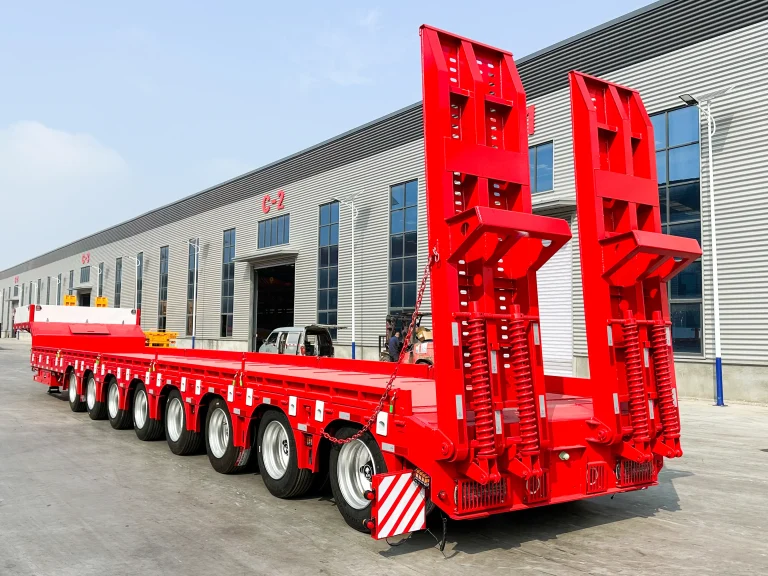
Heavy equipment transport becomes more demanding when cargo is long, heavy, or difficult to load on a standard trailer. Poor axle distribution, limited deck space, and unsuitable loading ramps can increase operating risk. CHENLU recently completed a new 8 axle flatbed semi trailer for shipment, designed for demanding heavy-duty transport applications.
An 8 axle flatbed semi trailer uses a multi-axle chassis to distribute heavy loads across a longer running gear layout. Combined with a long loading deck, front gooseneck, rear loading ramps, and multiple tie-down points, this type of trailer is suitable for construction machinery, industrial equipment, mining machinery, and other heavy project cargo.
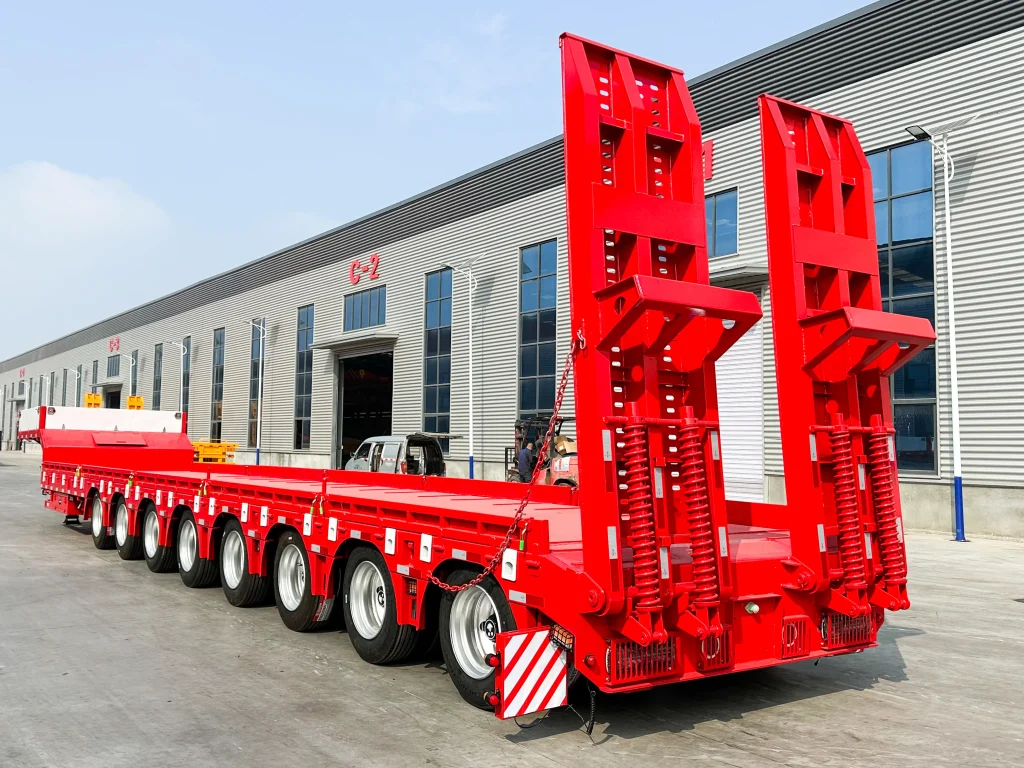
Why Was an 8 Axle Flatbed Semi Trailer Selected?
For heavy transport projects, the trailer configuration must match more than cargo weight.
The buyer also needs to consider cargo dimensions, center of gravity, loading method, road conditions, tractor specification, axle-load limits, and local transport regulations.
This customized 8 axle flatbed trailer uses a long multi-axle chassis that provides more positions for distributing the transported load. Compared with a standard three-axle or four-axle semi trailer, the eight-axle layout is intended for more demanding heavy-duty transport requirements.
However, axle quantity alone does not define legal payload. The final permitted load depends on the complete vehicle configuration and local regulations.
For this reason, CHENLU develops multi-axle trailers according to the customer’s real transport conditions rather than simply increasing the number of axles.
What Can an 8 Axle Flatbed Trailer Transport?
A heavy-duty flatbed trailer with multiple axles can be used for many types of machinery and project cargo.
Typical applications may include:
– Excavators
– Bulldozers
– Wheel loaders
– Road construction machinery
– Mining equipment
– Agricultural machinery
– Industrial machinery
– Steel structures
– Large mechanical components
– Infrastructure project equipment
The long open platform also gives operators greater flexibility when transporting cargo with different lengths and shapes.
Unlike an enclosed trailer, the flat loading deck allows equipment to be accessed from the rear, side, or above, depending on the loading method.
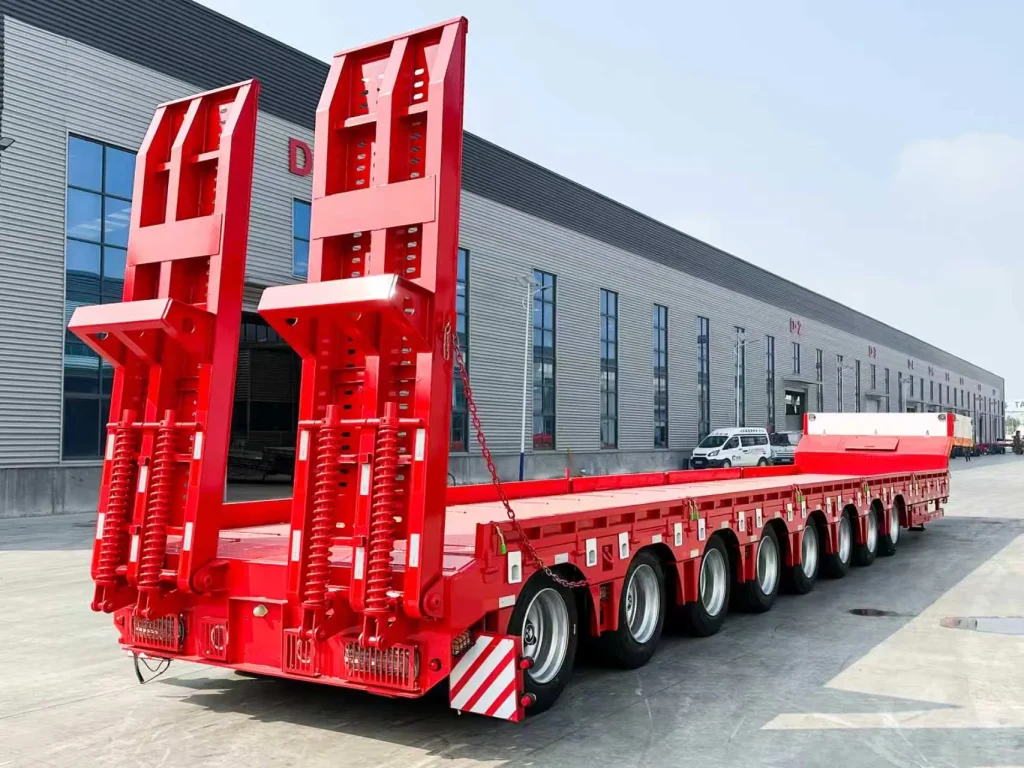
Multi-Axle Design for Heavy Load Distribution
One of the most visible features of this trailer is its eight-axle running gear.
For heavy cargo, load distribution is critical. If too much weight is concentrated on a small axle group, tire load, suspension stress, road compliance, and vehicle stability may all become concerns.
A multi-axle structure helps distribute load across more axle positions when the chassis and local regulations are designed for that arrangement.
Important engineering factors include:
| Configuration Area |
Por qué es importante |
| Cantidad de ejes |
Supports load distribution |
| Capacidad nominal del eje |
Determines individual axle capability |
| Distancia entre ejes |
Affects legal and structural load distribution |
| Suspensión |
Transfers load between chassis and axles |
| Llantas |
Must match axle and operating loads |
| Estructura principal |
Carries bending and torsional forces |
| Carga del eje central |
Affects tractor and trailer balance |
| Posición de carga |
Influences axle-group loading |
For international projects, these factors should be confirmed before production.
Long Flatbed Platform for Large Machinery
The trailer shown in this shipment uses an extended open loading deck.
A long platform can be useful when the customer needs to transport machinery or industrial cargo that cannot fit safely on a shorter standard trailer.
The open deck also supports flexible cargo positioning.
For example, an excavator may need different weight distribution from a steel structure. A long industrial component may require different tie-down positions from a loader.
This is why deck length and axle layout should be designed together.
A longer trailer is not automatically better. Turning radius, road width, local dimension rules, tractor compatibility, and transport route all need to be considered.
Heavy-Duty Rear Loading Ramps
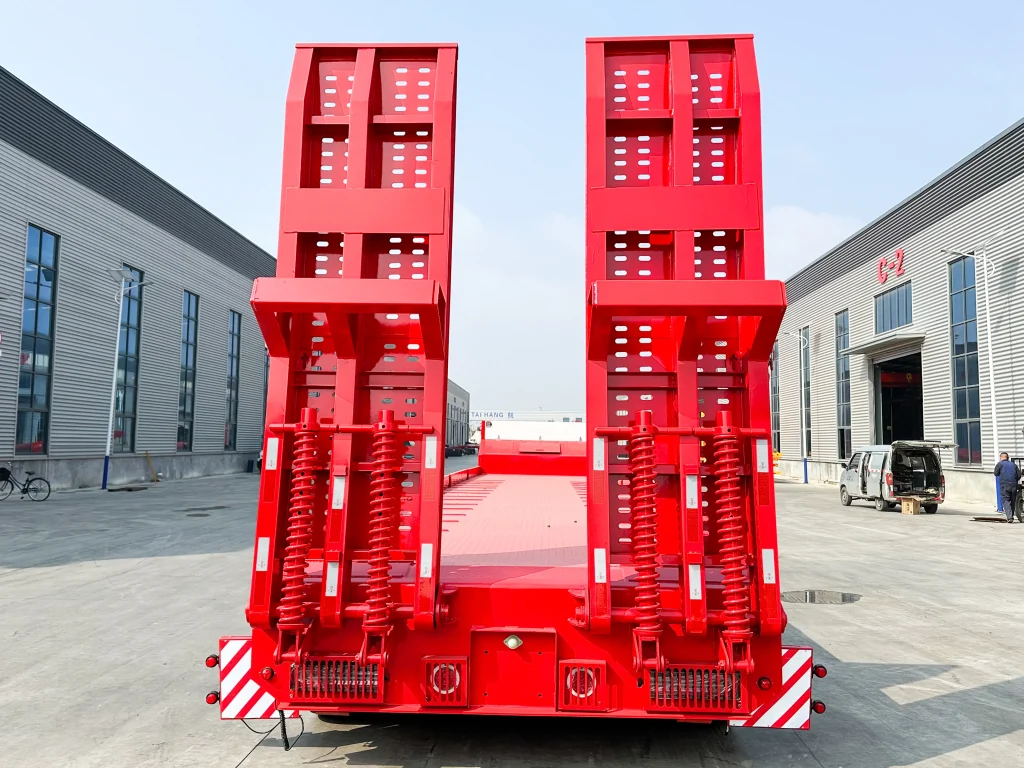
The photographs show two large rear loading ramps.
These ramps allow suitable wheeled or tracked machinery to move from ground level onto the trailer deck.
The ramp structure also uses visible spring-assisted mechanisms. This type of design helps reduce the manual effort required to raise and lower the ramps during daily operation.
For heavy-equipment fleets, ramp design should consider:
– Equipment width
– Track spacing
– Machine ground clearance
– Loading angle
– Equipment weight
– Job-site surface conditions
A bulldozer and an excavator may require different loading angles and ramp spacing, so the final configuration should follow the machinery that the customer plans to transport.
Multiple Cargo Securing Points Along the Trailer
Heavy machinery must remain secure during acceleration, braking, cornering, and uneven-road operation.
The side of this trailer includes multiple visible securing points distributed along the platform.
These provide operators with more options for chains, straps, and other suitable restraint equipment.
Different cargo requires different tie-down positions. For example:
– Excavators may use chassis and track-frame securing points.
– Loaders may require front and rear restraint positions.
– Steel structures may need several distributed tie-down locations.
– Industrial machinery may require reinforced fixing points close to its center of gravity.
For OEM projects, CHENLU can configure the quantity and position of cargo securing points according to the customer’s transport requirements.
Cajas de herramientas prácticas y protecciones laterales
The trailer is also equipped with integrated side toolboxes.
These storage spaces can help operators carry commonly used equipment such as:
– Chains
– Straps
– Hand tools
– Gloves
– Wheel tools
– Maintenance accessories
– Cargo securing equipment
Side protection structures and reflective markings are also visible along the trailer.
For export projects, these components can be adjusted according to customer requirements and destination-market regulations.
Small details like tool storage, spare tire placement, lighting, and side protection can make a large difference in daily fleet use.
Why Heavy-Duty Flatbed Trailers Need OEM Customization
A heavy transport trailer should not be selected only by axle number.
Two 8 axle trailers may look similar but operate very differently if they use different:
– Platform lengths
– Main beam structures
– Axle ratings
– Suspension systems
– Tire sizes
– Ramp designs
– Cargo securing layouts
– Brake systems
– Kingpin positions
As a professional semi trailer manufacturer in China, CHENLU provides OEM and ODM solutions for heavy-duty transportation projects.
Customization can include:
– Overall dimensions
– Platform length and width
– Deck height
– Number of axles
– Axle rating and brand
– Suspension system
– Main frame reinforcement
– Loading ramps
– Tire and rim configuration
– Landing gear
– Toolboxes
– Cargo securing points
– Spare tire carriers
– Lighting system
– Paint color
– Customer logo
The final design should always be based on the cargo and operating route.
Built for Construction, Mining and Infrastructure Logistics
Multi-axle flatbed trailers are especially relevant for industries where machinery and project components need to move regularly.
Construcción
Contractors may need to move excavators, loaders, road machinery, and prefabricated components between different project sites.
Mining
Mining companies often transport heavy equipment between mines, maintenance bases, and operating areas.
Infrastructure
Large infrastructure projects may require the movement of machinery, steel structures, generators, transformers, or other oversized industrial components.
Heavy Equipment Rental
Rental companies often transport several machine types, making flexible deck space and multiple securing points valuable.
For these customers, trailer downtime directly affects project efficiency. The trailer must therefore balance structural strength, load distribution, serviceability, and practical loading.
How Does CHENLU Control Quality Before Shipment?
Heavy-duty trailer quality depends on more than the final paint finish.
CHENLU’s production process includes material preparation, structural fabrication, welding, frame assembly, surface treatment, running-gear installation, electrical and braking system assembly, and final inspection.
For a multi-axle trailer, important inspection areas include:
– Main frame dimensions
– Welding quality
– Axle alignment
– Suspension installation
– Landing gear
– Brake system
– Electrical system
– Ramp movement
– Tie-down points
– Tires and rims
– Reflective markings
– Surface finish
Before shipment, the completed trailer is checked according to the confirmed configuration.
For overseas customers, production photos and videos can also help track the manufacturing process before delivery.
Preguntas frecuentes
What is an 8 axle flatbed trailer used for?
An 8 axle flatbed trailer is commonly used for heavy machinery, construction equipment, mining equipment, industrial machinery, and large project cargo that requires a longer deck and multi-axle load distribution.
Does an 8 axle trailer automatically carry more weight?
No. Axle quantity alone does not determine legal payload. Chassis strength, axle ratings, tires, suspension, tractor configuration, weight distribution, and local regulations all affect permitted capacity.
Can the loading ramps be customized?
Yes. Ramp width, structure, spacing, and loading angle can be adjusted according to the machinery the customer plans to transport.
Can CHENLU customize the platform length?
Yes. Platform dimensions can be designed according to cargo size, destination regulations, tractor configuration, and transport route.
What information is needed before ordering?
Customers should provide the cargo type, cargo dimensions, operating weight, destination country, road conditions, tractor information, required platform size, and preferred axle configuration.
Can the trailer color and logo be customized?
Yes. Paint color, company logo, identification markings, toolboxes, and selected accessories can be customized according to the confirmed order.
CHENLU Completes New 8 Axle Flatbed Trailer Shipment
This 8 axle flatbed semi trailer shipment reflects CHENLU’s ability to manufacture customized heavy-duty transport equipment for demanding logistics, construction, mining, and infrastructure applications.
The long loading platform, multi-axle layout, rear loading ramps, cargo securing points, and practical side accessories are designed to support real heavy transport work.
For fleet owners, contractors, distributors, mining companies, and international project buyers, the best trailer configuration starts with the cargo.
If you are planning a heavy-equipment transport project, send CHENLU your:
– Cargo type
– Cargo dimensions
– Operating weight
– Destination country
– Road conditions
– Tractor specification
– Required axle configuration
Our engineering team can prepare a customized 8 axle flatbed trailer or other heavy-duty semi trailer solution for your project.




 19 October 2026